Lot Size in Forex Explained: Standard, Mini, Micro, Nano

Lot size in forex is the single number that decides how much money each price move puts into or takes out of your account. A lot is simply the unit you trade forex in: when you place a trade you are buying or selling a set number of units of the base currency (the first currency in a pair) priced in the quote currency (the second). Instead of typing out 100,000 units every time, the market groups those units into named lot sizes, and your platform shows them as a single number like 1.00 or 0.01. That number is the main lever on your risk. A bigger lot moves more money per pip, so the same price move hands you a bigger gain and, just as easily, a bigger loss. Getting the lot size right is the difference between a small, survivable losing trade and one that wipes out a chunk of your account.
TL;DR
- A lot is the trade-size unit in forex. One standard lot (1.00) is 100,000 units of the base currency.
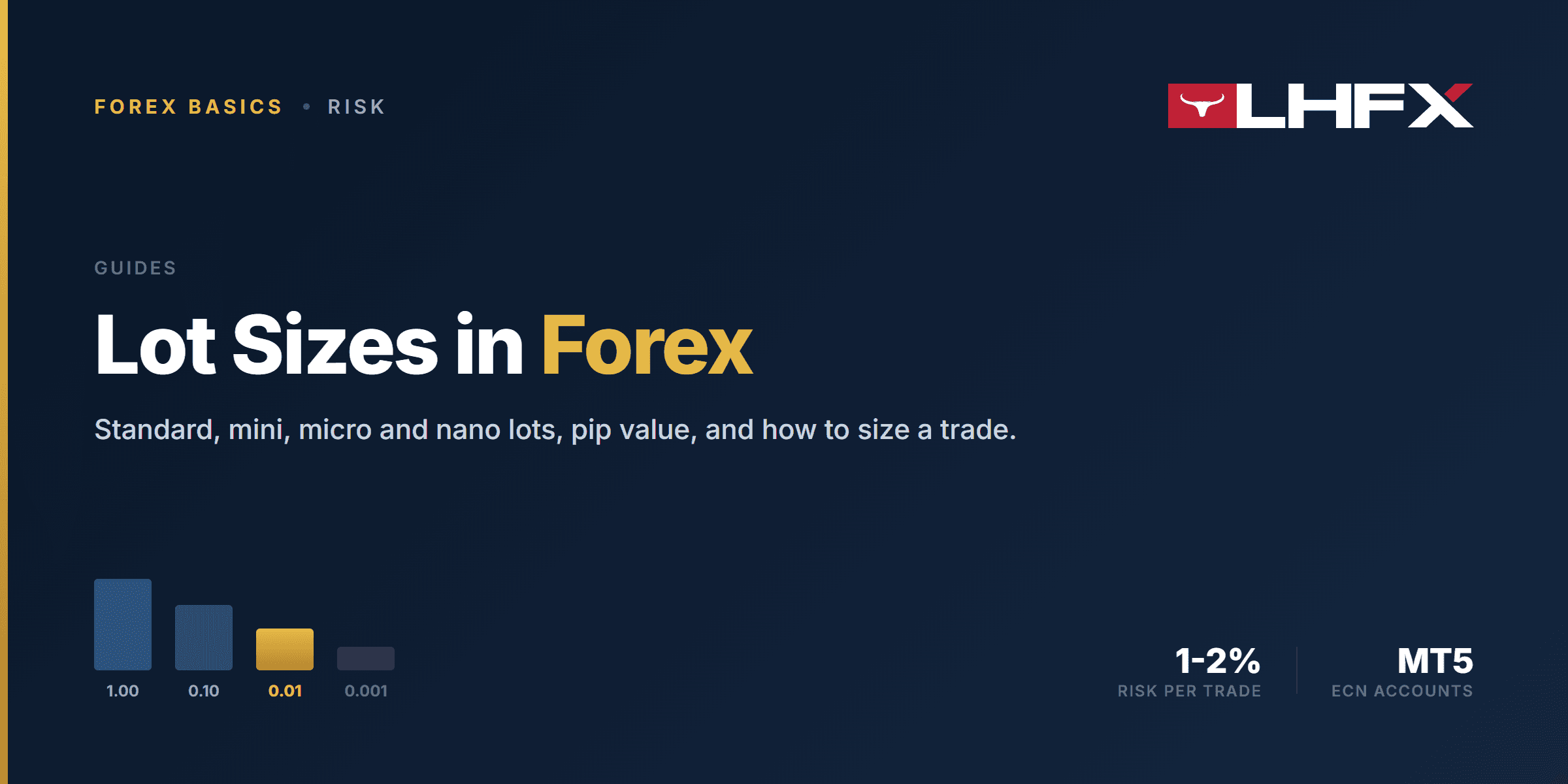
- The four common sizes are standard (1.00), mini (0.10), micro (0.01), and nano (0.001). Each step down is ten times smaller.
- A mini lot (0.10) is one tenth of a standard lot, a micro lot (0.01) is one hundredth, and a nano lot (0.001) is one thousandth.
- On a USD-quoted pair the pip values are about $10 per pip for a standard lot, $1 for a mini, $0.10 for a micro, and $0.01 for a nano.
- Bigger lots mean bigger losses too, not just bigger wins. Size from your account balance and your stop-loss, not from how confident you feel.
- On a small account, start on micro (0.01) or nano (0.001). On MetaTrader 5 the usual smallest tradable size is 0.01.
The four forex lot sizes: standard, mini, micro and nano
A lot is just a fixed bundle of currency units. Forex is quoted in four standard lot sizes, and every position you open is some multiple of one of them. The bigger the lot, the more each price move is worth to your account, in both directions.
| Lot type | Shown on your platform as | Units of the base currency |
|---|---|---|
| Standard lot | 1.00 | 100,000 |
| Mini lot | 0.10 | 10,000 |
| Micro lot | 0.01 | 1,000 |
| Nano lot | 0.001 | 100 |
Read the notation the way MetaTrader 5 shows it. 1.00 is one standard lot, 0.10 is one mini lot, 0.01 is one micro lot, and 0.001 is one nano lot. You can trade fractions and multiples of these too, so 0.50 is half a standard lot and 0.05 is five micro lots. A few things to keep in mind:
- Standard lots are large. 100,000 units means a full-sized position, shown as 1.00. This is where most beginners get into trouble, because the money at risk on a single trade climbs fast.
- Mini and micro lots are the everyday sizes for smaller accounts. A micro lot (0.01) is 1,000 units and lets you trade with a fraction of the exposure of a standard lot, which is why it suits a small balance.
- Nano lots are the smallest step. At 100 units, shown as 0.001, they let you keep risk tiny while you learn. Not every broker offers them, so check before you rely on that size.
Whichever size you pick, the trade-off works both ways: a larger lot magnifies a winning move and an equally sized losing move, so size down and use a stop-loss until you have a plan you trust. The smaller the number, the less each pip is worth and the less a bad trade can hurt you, which is exactly why beginners should start at the bottom of that table.
What a lot is worth: pip value per lot size
Your lot size decides how much one pip is worth. A pip is the smallest standard price move on most pairs, the fourth decimal place (0.0001) on pairs like EUR/USD. The bigger your lot, the more money each pip move adds or subtracts from your account.
On pairs where the US dollar is the quote currency (the second currency, as in EUR/USD or GBP/USD), the pip values below hold as clean, round numbers. That makes them easy to plan around.
| Lot notation | Pip value (USD-quote pair) |
|---|---|
| 1.00 | About $10 per pip |
| 0.10 | About $1 per pip |
| 0.01 | About $0.10 per pip |
| 0.001 | About $0.01 per pip |
Read it as a simple scale. Every step down divides your pip value by ten. A standard lot at 1.00 moves about $10 a pip, a mini at 0.10 moves about $1, a micro at 0.01 moves about $0.10, and a nano at 0.001 moves about a cent.
This cuts both ways. A 20 pip move in your favour on a single standard lot is roughly $200, but the same 20 pips against you is roughly a $200 loss. Bigger lots do not just raise your upside, they raise how fast your balance can drop. On a small account that is the difference between a normal losing trade and a blown account, which is why most beginners are better off starting at micro (0.01) or nano (0.001) while they learn.
Two things shift these numbers. On pairs where the dollar is not the quote currency, the exact pip value depends on the current exchange rate rather than landing on a round figure, so treat the table as the USD-quote baseline. And on JPY pairs a pip is the second decimal (0.01), not the fourth, though the per lot dollar values above still apply. Your MetaTrader 5 order ticket shows the live pip value for the pair and lot size you have selected before you commit, so you never have to guess.
How lot size, leverage and margin fit together
Lot size sets how much you can lose or gain per pip. Leverage sets how little cash you need to hold that position open. They are two different things, and confusing them is how small accounts blow up.
Start with the position itself. One standard lot is 100,000 units of the base currency. One mini lot is 10,000 units, one micro lot is 1,000 units, and one nano lot is 100 units. On a USD-quote pair like EUR/USD, that works out to roughly $10 per pip on a standard lot, $1 per pip on a mini lot, and $0.10 per pip on a micro lot. That per-pip figure is your real exposure. It does not change just because your broker lets you open the trade with a small deposit.
Leverage is the second piece. It decides the margin, which is the slice of your balance the broker sets aside to keep the position open. At 1:500, the maximum leverage available at LHFX, a 100,000-unit standard lot needs about 200 units of the base currency in margin. The other side of that trade is still moving at roughly $10 a pip. Leverage does not add free capital; it adds risk against a smaller deposit. The margin looks small, but the position sizing, and the loss if the market moves against you, is set by the lot, not by the margin.
Here is the trap. A trader sees that a standard lot only ties up a couple of hundred dollars in margin and assumes that is the amount at risk. It is not. A 50 pip move against a standard lot is around $500, whether the margin was $200 or $2,000. If the account holds $500 total, that single move can wipe it out and trigger a margin call, where the broker closes positions to stop the balance going negative.
So read the two numbers separately every time you open a trade:
- Lot size tells you the money per pip, and therefore the size of your loss if your stop is hit.
- Leverage and margin tell you how much of your balance is locked up while the trade is open.
Size the trade from the first number, using your stop distance and how much of the account you are willing to lose. Let the margin simply confirm the position fits inside your balance with room to spare. Trading bigger lots on high leverage means bigger losses just as fast as bigger gains, so a stop-loss on every position is not optional.
Position sizing: pick a lot size that risks only 1-2%
Risk no more than 1% to 2% of your account balance on any single trade. On a $1,000 account that caps the loss at $10 to $20 per position. Your lot size is simply whatever number keeps a losing trade inside that cap, so you work it out backwards from the loss you are willing to take, not from how many lots you feel like trading.
Three steps get you there:
- Set your dollar risk. Take 1% to 2% of your balance. On $1,000 that is $10 to $20.
- Set your stop distance in pips. This comes from the trade and where your invalidation level sits, not from your account size. Say your stop is 20 pips away.
- Turn that into a lot size. Divide the dollar risk by the stop distance to get the pip value you can afford, then pick the lot that matches it. A $10 risk over a 20-pip stop is $0.50 per pip. A micro lot is worth about $0.10 per pip on a USD-quoted pair, so $0.50 divided by $0.10 is 5 micro lots, or 0.05 lots.
So a $1,000 account risking 1% with a 20-pip stop trades 0.05 lots. Widen the stop to 25 pips and the same $10 risk falls to $0.40 per pip, about 0.04 lots. Tighten the stop and you can trade a slightly larger lot for the same dollar risk. The stop distance and your risk cap decide the lot for you.
That is also why smaller balances sit better on micro and nano lots, which the next section covers in full.
Small accounts: why start on a micro lot
If you are funding your account with $100 or $200, the micro lot is where you should start. It lets you trade real money without one bad position ending your account on the first day.
Here is the math on a $100 account. A micro lot (0.01) is worth about $0.10 per pip on a USD-quoted pair. Put a 50-pip stop loss on the trade and your maximum loss is about $5. On $100 that is 5% at risk, already at the upper edge of what most traders should put on a single trade. On a $200 account the same $5 stop is 2.5%, which gives you more breathing room.
Compare that to a mini lot (0.10) at about $1 per pip. The same 50-pip stop would risk $50, or half of a $100 account, on one position. So for a $100 balance the honest answer to "what lot size should I use" is 0.01, the micro lot. It is not a beginner's consolation prize. It is the size that leaves room to be wrong a few times and keep trading.
One thing that trips people up: a micro lot still needs a tight, pre-planned stop. Small size lowers your dollars per pip, but it does not cap your loss by itself. Without a stop, a micro lot caught in a fast move can still run much further than you planned. Trading always involves a real risk of loss, so starting small is what keeps a mistake survivable while the stop loss does the actual protective work at every size.
Lot-size mistakes that drain accounts
Most blown accounts are not blown because the trader was wrong on direction. They are blown because the lot size was wrong for the balance. Overleveraging turns one normal losing trade into a serious dent, and a run of them into a wipeout. The four mistakes below are the ones that do the damage.
| Mistake | Why it drains you | The fix |
|---|---|---|
| Trading too large for the balance | A standard lot risks about $10 per pip, so a 50-pip stop is $500 gone on a small account | Size from a fixed percent, usually 1% to 2% of the balance |
| Ignoring pip value | The real dollar risk becomes a surprise after the fact | Convert your stop distance to dollars before you click buy |
| Removing or widening the stop loss | A small planned loss becomes an open-ended one | Keep the stop where you set it and let the size flex instead |
| Increasing lot size after a loss to recover | Overleveraging on tilt, faster losses stacked on losses | Keep the same percent risk every trade, win or lose |
Every fix is the same discipline: size from a fixed percent and a real stop. Bigger lots do not just mean bigger wins. They mean bigger and faster losses, and forex trading carries a real risk of losing your capital.
Trade the right lot size on LHFX
LHFX is an STP/ECN MetaTrader 5 forex broker, so your orders route straight through to the market and you keep micro-lot trading on every pair. That means you size positions to your account instead of being forced into large lots. A 0.01 micro lot on a USD-quote major moves about $0.10 per pip, which is a sensible place for a small balance to start.
You open an ECN account, trade forex and CFDs, and fund by card or crypto.
New to this? Build the base first: what is leverage in forex, how to trade forex, and forex trading for beginners.
Bigger lots mean bigger losses too. Choose a lot size you can afford to be wrong on, and trade with a stop every time.
Frequently asked questions
What is lot size in forex?
Lot size is the number of currency units in one trade. Forex uses four fixed sizes: a standard lot is 100,000 units, a mini lot is 10,000, a micro lot is 1,000 and a nano lot is 100. The bigger the lot, the more each pip of price movement is worth, so lot size decides how much money you win or lose per pip.
How do you calculate lot size in forex?
Size from risk. Pick the amount you will risk on the trade, for example 2% of your account, then take your stop-loss distance in pips and the pip value of one lot size. Divide your risk amount by (stop distance times pip value) to get how many lots to trade. On a $500 account risking $10 with a 50-pip stop, a micro lot at about $0.10 per pip loses about $5 over 50 pips, so roughly two micro lots keeps the loss near your $10 limit.
How much is 0.01 lot size in dollars?
A 0.01 lot is a micro lot, which is 1,000 units of the base currency. On a USD-quoted pair like EUR/USD its pip value is about $0.10 per pip, so a 50-pip move is worth about $5. The margin you put up to open it is only a small fraction of the 1,000-unit notional value, and it depends on your leverage.
How much is 0.1 and 1 lot in dollars?
A 0.1 lot is a mini lot (10,000 units) worth about $1 per pip on a USD-quoted pair, and a 1.0 lot is a standard lot (100,000 units) worth about $10 per pip. So a 50-pip move is about $50 on a mini lot and about $500 on a standard lot. These are illustrative figures; the exact value depends on the pair and quote currency.
What lot size is good for a $100 forex account?
Start on a micro lot (0.01) or smaller. At about $0.10 per pip, a 50-pip loss on one micro lot is about $5, which is already 5% of a $100 account. That is why a small balance needs a tight stop and often less than a full micro lot per trade, so no single loss can wipe out the account.
What is the smallest lot size in forex?
The micro lot (0.01, or 1,000 units) is the smallest size offered on most retail accounts, and some brokers also offer nano lots (100 units). Smaller sizes exist specifically so traders with small accounts can control their risk per trade.
What is a standard lot size in forex?
A standard lot is 100,000 units of the base currency, shown as 1.00 on your platform. On a USD-quoted pair it is worth about $10 per pip, so it moves your account fast and is generally too large for a beginner or a small balance.