Inducement in Forex: How the Liquidity Trap Works

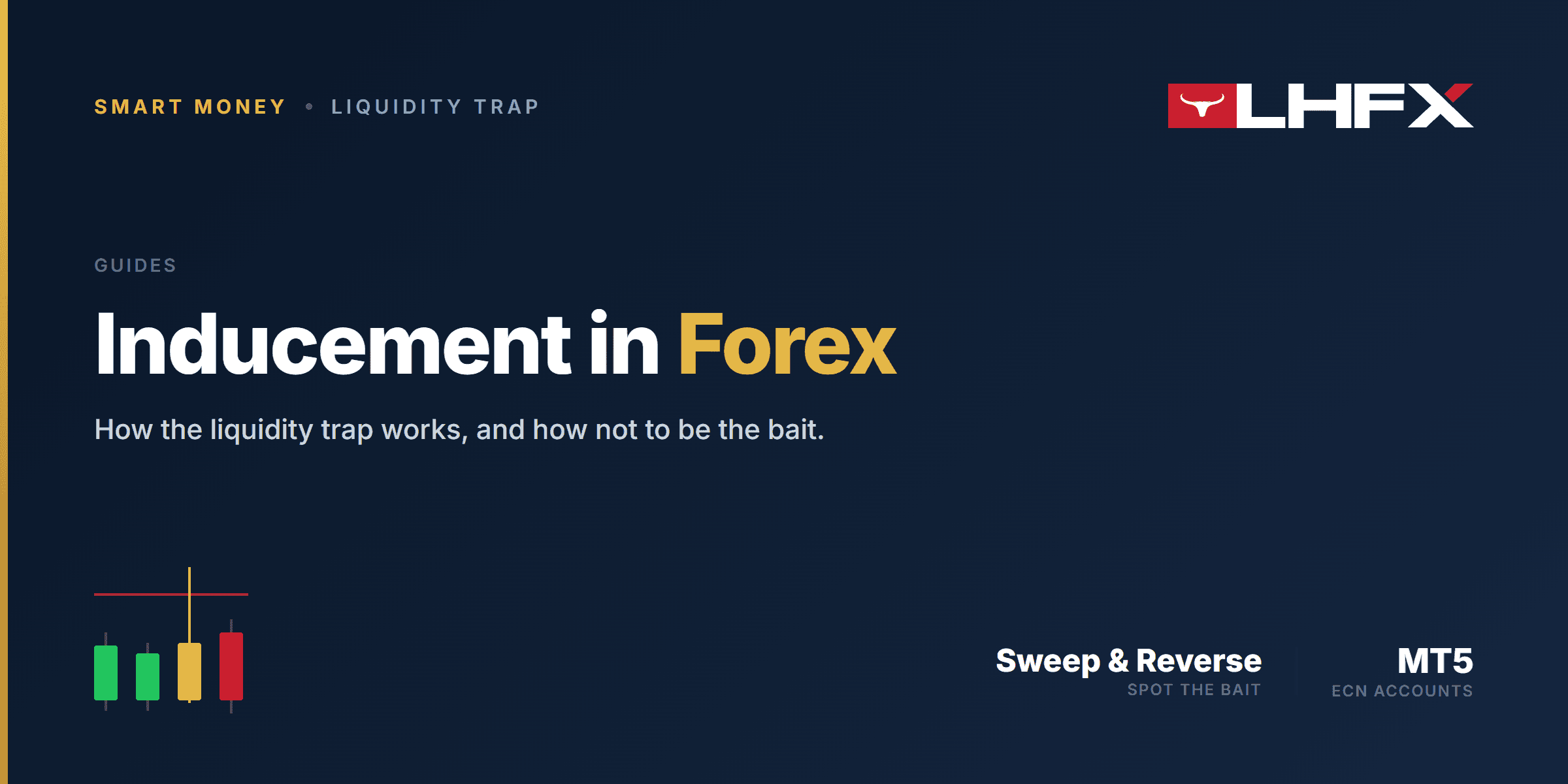
Inducement in forex is a deliberately obvious price level that lures traders into positions, so the cluster of stop orders they leave behind can be swept for liquidity before price reverses toward its real target.
TL;DR
- Inducement is bait: an obvious support, resistance, or trendline that pulls traders in.
- Those traders leave stop orders bunched in a tight zone, which is the liquidity larger participants need to fill their own size.
- Price runs that zone (a liquidity sweep), then reverses away from it.
- Inducement sits between the current price and a valid order block, and it is what makes that order block valid.
- Spotting it is a chart-reading skill, not a guess, and this guide gives you the exact steps.
Picture the level that looks too clean to ignore: a support line touched three times, an equal-highs pattern, a tidy trendline. It looks like the safe entry, so traders pile in and stack their stops just beyond it. That stack is the point. Price pushes through, triggers the stops, collects the liquidity, and turns back the other way. The obvious trade was the trap, and the reversal was the plan.
The rest of this guide walks through how to read inducement on a live chart, how it connects to liquidity sweeps and market structure, and how to avoid getting caught by it yourself.
What is inducement in trading?
You already have the definition from the intro. The part that actually helps you at the chart is telling a real inducement apart from any ordinary obvious level, because most obvious levels are just that: obvious.
Not every obvious level is inducement. What qualifies a level is context, meaning where it sits in relation to a stronger zone behind it. Inducement is the closest tempting target sitting in front of that zone, and it usually looks too clean or too easy. A tidy trendline everyone is watching, or a swing low the whole market can see. If a level looks like the free trade everyone has already spotted, treat that as a warning rather than an invitation. This is the same idea people mean by what is inducement in SMC.
Keep two terms separate while you are here. Inducement is the setup, the bait level itself. The liquidity sweep, also called a liquidity grab, is the event: the moment price runs through that level and clears the orders resting on it. One is the trap, the other is it springing.
A quick illustration: on EUR/USD, a run of equal highs that every chart shows plainly is a classic inducement candidate. The cleaner it looks, the more orders tend to be stacked around it.
How inducement actually works: the liquidity trap
Inducement is bait. It is a price level obvious enough that a lot of traders act on it, sitting exactly where their orders become fuel for someone else's entry. The trap is that the level looks like an opportunity and functions as a pool of liquidity at the same time.
Here is the mechanic, step by step:
- An obvious level forms. Price leaves behind something clean and easy to read, like equal highs or a clear swing high. The kind of level you would draw on the chart without thinking twice.
- Orders pile up around it. Breakout traders queue buy stops just above it. Anyone already short parks a stop loss in the same zone. Both are resting orders, and above that high both are buys waiting to trigger.
- That cluster becomes a target. A group of resting orders is liquidity: a block of near-guaranteed fills sitting in one place. Larger participants need volume to fill size without pushing price against themselves, and this is where the volume is.
- Price is driven into the level. The push through the high looks like a breakout. Buy stops trigger, short stops trigger, and momentum traders chase it. Every one of those fills is a buy.
- Price reverses. There was never enough genuine demand above the level to hold it. Once the resting orders are consumed, price drops back through the level and the breakout traders are offside immediately.
The level that pulled everyone in was the inducement. It did its job the moment your order rested where it could be spent.
A simple illustration: on EUR/USD, price prints two highs at almost the same level, forming equal highs. That double top reads as textbook resistance, so shorts stack stops just above it while breakout buyers line up entries in the same place. Price pokes above both highs, fills that whole shelf of orders, then rolls over and heads lower. The equal highs were not resistance failing. They were the bait.
This is also why inducement and order blocks are joined at the hip. The reversal in that example does not come from nowhere. It usually fires from an order block, the zone where larger orders were actually positioned. The inducement is the tempting level sitting between current price and that order block, and clearing it is what lets price reach the block and turn. We cover the zone itself in the order blocks guide and the pooled-orders idea in the liquidity guide.
None of this guarantees a reversal. Levels break for real all the time, and treating every sweep as a trap is its own way to lose money. The point is to recognise that an obvious level is not automatically a safe one, and to ask who is meant to act on it before you do.
Where inducement sits: between price and a valid order block
This is the idea that ties the whole concept together, so it is worth slowing down on.
An order block is the last opposing candle before a strong move, the zone smart-money traders expect price to react from. But not every order block you can draw is worth trading. What separates a level price actually respects from one it slices straight through is whether there was inducement in front of it.
Picture the chart in front of you. Current price is at the top. The order block you want to buy from is lower down. In the gap between them sits a small, obvious level of liquidity: a recent low, a clean equal high, the stops of every trader who entered too early. That pocket of liquidity is the inducement, and its position is the whole point. It sits closer to price than the order block does.
What makes an order block valid
An order block is only valid if price has to sweep inducement to reach it.
That is the rule most explanations skate over. The order block is the destination. The inducement is the toll booth in front of it. Price does not drift gently down to a clean level and bounce. It reaches past the level first, grabs the liquidity resting just short of the order block, and only then reacts. The grab is not noise on the way to the zone. It is the signal that the zone is real.
Flip it around and the filter becomes obvious. If price can reach an order block without taking out any liquidity on the approach, there was nothing pulling it there and nothing to fund the reversal. That is an order block with no inducement, and it is exactly the kind that fails. So when you mark a level and see clean, untouched liquidity sitting just in front of it, you are not looking at two separate things. The liquidity is what qualifies the level.
How to read the order in practice
Reading it comes down to sequence. Find the order block first, the origin of the move you care about. Then look at the space between it and current price and ask a single question: what obvious liquidity is sitting there for price to take before it can get to my level?
If you can point to it, that is your inducement, and your order block has a reason to hold. If you cannot find any, treat the level with suspicion. Wait for price to actually clear the inducement before you trust the order block underneath it, rather than entering the moment price taps the zone. The traders who get stopped out at supposedly perfect levels are usually the ones who bought the order block before the inducement in front of it had been taken.
If any of the building blocks here feel thin, the order blocks and liquidity guides go deeper on each, and the market structure guide covers how these levels sit inside the larger trend.
How to identify inducement in forex on a chart
Inducement is easier to name than to see, so it helps to have a fixed routine instead of eyeballing every candle. The steps below are the simplest way to spot inducement in forex without talking yourself into a level that is not really there. Work top down and do them in order.
The core idea to hold onto: inducement always sits between current price and the valid order block you actually want to trade. It is the obvious liquidity price has to run through first. If you can find that liquidity, you have found the inducement.
How to identify inducement in forex, step by step:
- Mark your higher-timeframe order block or point of interest first. This is the zone you expect price to react from.
- Look at the space between current price and that zone, and find the most obvious level in it. Equal highs, equal lows, a clean trendline, a prior-day high or low, a visible swing point. If it is obvious to you, it is obvious to everyone.
- Ask where the crowd's stops and breakout orders would sit. That resting liquidity is the inducement.
- Wait for price to sweep that level rather than respect it. A quick spike through and back is the liquidity grab, not a real breakout.
- Look for a market structure shift right after the sweep, meaning price breaks back through the last short-term high or low.
- Only now treat the order block behind the swept liquidity as valid. The inducement getting taken is what confirms it.
Skip step 1 and you will keep labelling random swing points as order blocks. The inducement is the filter that tells you which zone is worth trading and which is bait.
Shapes that tend to act as inducement
Most inducement shows up as one of a handful of recognisable chart shapes. Learn these and you spot the trap faster.
| Shape | What it looks like | Why traders take the bait |
|---|---|---|
| Equal highs or equal lows | Two or more touches at the same price | Looks like a clear support or resistance, so stops stack just beyond it |
| Trendline | Three or more aligned swing points | Breakout and pullback traders lean on it as if it were a rule |
| Prior-day or session high or low | A clean horizontal carried from the last session | Widely watched reference level, so orders cluster there |
| Minor swing high or low | A small pivot sitting just ahead of your point of interest | Short-term stops sit right beyond it, easy to sweep |
| Round number | A .00 or .50 psychological level | Manual stops and pending orders bunch up at the round figure |
Illustrative only: equal highs on EUR/USD, an obvious ascending trendline on AUD/USD, a clean prior-day low on USD/JPY. In each case the shape is the lure, and the valid order block is waiting on the far side of it.
How to avoid being the induced liquidity
You cannot predict every trap. The realistic goal is to stop entering at the exact spots that are built to catch you. A few habits do most of the work.
Distrust the obvious level. If a high, low, or trendline is so clean that every chart shows it and every trader would take the same breakout, treat it as a target rather than a signal. The clearer the level, the more orders rest around it, and the more reason price has to run it first.
Wait for the sweep, then the reaction. Instead of buying the breakout above an obvious high, let price take that high and watch what follows. If it runs the level and then shifts structure back the other way, the inducement has already done its job and you are reading the real move instead of feeding it. On GBP/JPY, that often looks like a fast spike through a run of equal highs followed by an immediate rejection.
Mark the order block behind the bait, not the bait itself. Inducement sits in front of the level you actually want to trade from. Once price sweeps the obvious pool, drop to a lower timeframe and look for your entry at the zone behind it, with confirmation, rather than at the tempting level everyone else used.
Put your stop where the idea is wrong, not where it is obvious. Stops parked just beyond the clean high or low are the liquidity. Anchor your stop to the structure of the level you traded from, past the point that would genuinely invalidate your read, and size the position so that stop is affordable.
Slow down at the open and around news. Sweeps are cheapest to engineer when liquidity is thin or emotions are running high. XAU/USD around a scheduled data release is a common place to get induced, so let the first burst settle before you commit.
None of this makes you immune. This does not prevent losses, and no read on the chart is ever guaranteed. Inducement is a lens for understanding why a clean breakout failed, not a system that removes risk. Losses are part of trading these patterns and nothing removes them. What good habits do is keep you out of the worst entries and keep your size sensible for the sweeps that still catch you.
If you want to go deeper on the pieces this section leans on, read our guides to order blocks, liquidity, and market structure.
How inducement in forex fits with the rest of smart money concepts
Inducement is not a standalone idea. It only makes sense next to the other smart money concepts, and most traders mix it up with the terms sitting right beside it. Here is how it connects, and where the differences actually matter.
Inducement vs a liquidity grab or liquidity sweep. A liquidity grab is the event: price runs past a level, triggers the resting orders, then reverses. Inducement is the reason those orders were resting there to begin with. One is the action, the other is the setup that baited it. For the mechanics of how pools build and get taken, read Liquidity in Forex.
Inducement vs the order block. These two work as a pair, not as competitors. The order block is the zone smart money is actually trying to reach. The inducement is the closer level that gets retail traders to commit early, before price arrives at that zone. Telling a valid order block apart from a random candle is the other half of this skill, and it has its own guide in Order Block in Forex.
Inducement vs market structure. Market structure tells you which pools are worth watching in the first place. Once you can read the swing points on the chart, inducement is where you expect the fakeout to happen relative to them. Structure is the map. Inducement is the specific spot on that map you learn to distrust. The reading itself is covered in Market Structure in Forex.
Inducement and the fair value gap. A fair value gap is a separate confirmation tool, an imbalance left behind by a fast move. It often appears as price leaves an inducement level and runs toward the order block, which is why the two come up in the same breath even though they describe different things. If price sweeps inducement and then leaves a clean gap on the way to the order block, you are usually looking at the same move from two angles rather than two signals.
Frequently asked questions
What is inducement in forex?
Inducement is an obvious, minor liquidity level, often a small swing high or low or a clear trendline, that lures breakout and early traders into positions. Their stop losses then become the liquidity that pushes price to a stronger point of interest such as an order block. In short, it is bait that sits in the path of the real move.
How do you identify inducement in forex?
Start from higher timeframe structure and mark the real order block or point of interest. The inducement is the obvious liquidity resting between current price and that zone, usually equal highs or lows, a clean prior high or low, or an obvious trendline. If a level is the first thing your eye jumps to, other traders see it too, which is what makes it inducement.
What is the difference between inducement and a liquidity sweep?
Inducement is the setup: the obvious level where orders and stops pool. A liquidity sweep or liquidity grab is the event: price running through that level to trigger those orders before reversing. Inducement is the bait; the sweep is price taking it.
What is inducement in SMC?
In smart money concepts, inducement is the engineered liquidity that makes an order block valid. A genuine order block usually has inducement in front of it, so price sweeps the obvious level first, then reacts from the real zone. If there is no liquidity for price to grab first, the zone is more likely to fail.
How do you avoid being the induced liquidity?
Avoid entering on the obvious break and avoid resting your stop right behind the level everyone else uses. Wait for the inducement to be swept and for a market structure shift to confirm, then look for entries from the order block or a fair value gap. This reduces some traps, but no method removes risk, so a defined stop and sensible position size still matter on every trade.
Is inducement the same as an order block?
No. An order block is the zone price is drawn to react from, the destination. Inducement is the obvious liquidity in front of it that traders get trapped in first. They work together: inducement typically sits between current price and a valid order block.