How Much Money Do You Need to Start Forex Trading?

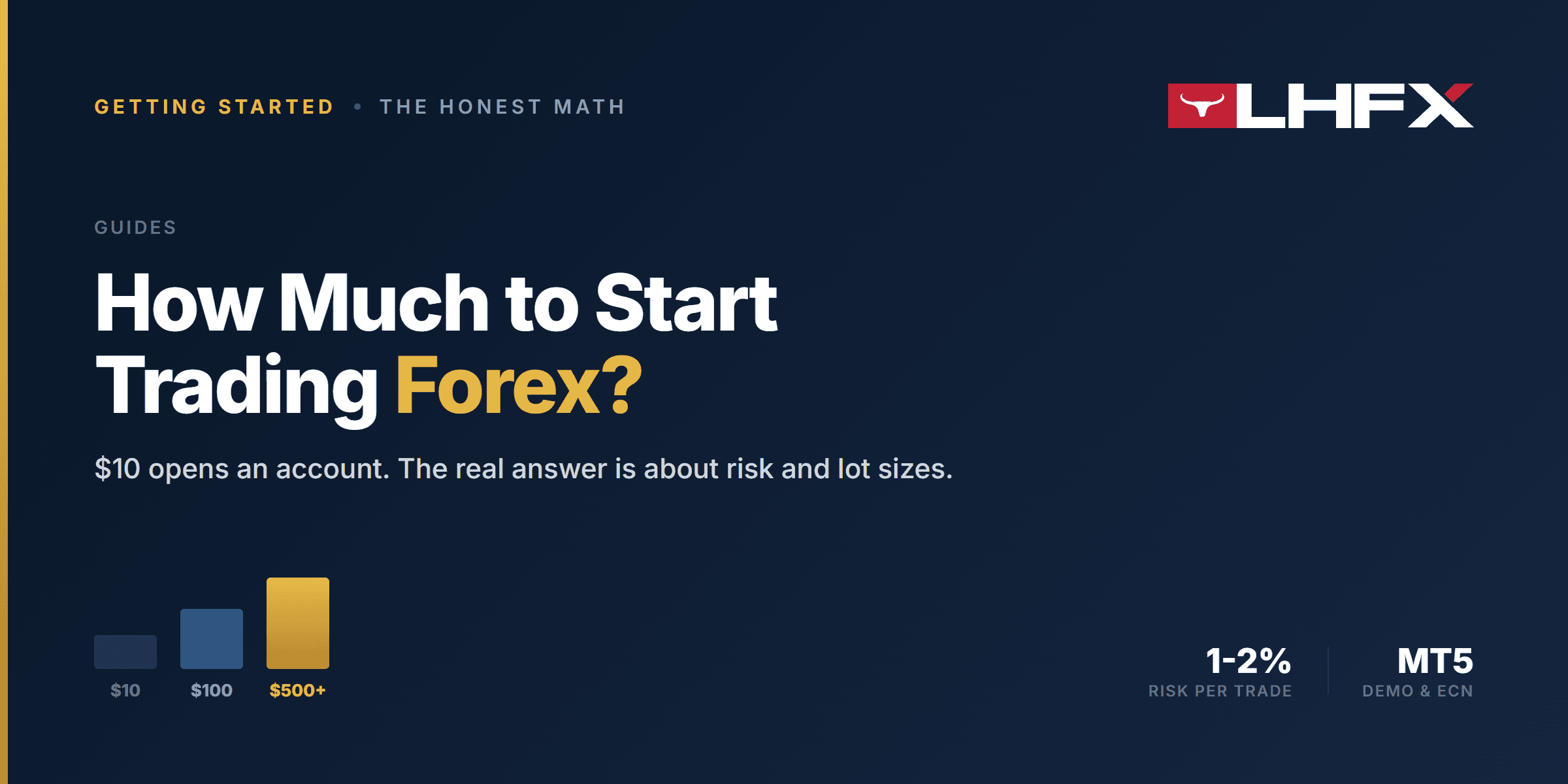
How much money you need to start forex trading has two honest answers, and they are not the same number. You can open a live LHFX account and place a real trade from a $10 minimum deposit, so technically you can start with very little. A more realistic starting amount is closer to $100, because that gives you room to risk a sensible 1-2% per trade while each position still means something. This guide walks through the real math: lot sizes, risk per trade, spread and commission, and what you should actually fund.
TL;DR
- $10 is the technical minimum you can open an LHFX account with, and it is enough to place a real trade.
- Around $100 is a more realistic starting point, because it lets you risk 1-2% per trade without spread and commission eating the account.
- The smallest standard lot on most MT5 accounts is 0.01 (a micro lot), which quietly sets the floor on how little you can risk.
- Start small, use a stop-loss on every trade, and only risk money you can afford to lose.
- Most retail traders lose money, so treat your first months as learning, not earning.
How much money do you need to start forex trading? The short answer
There are two numbers that matter, and they are not the same.
The first is the technical minimum. You can open a live account and place a real trade with a $10 deposit at LHFX. That is enough to fund an account, size a micro lot, and put on a position with a stop-loss. So the honest answer to "can I start forex with $10" is yes.
The second is a realistic starting amount, and for most beginners that is closer to $100. A larger balance gives you room to risk a sensible 1-2% per trade while still keeping each trade meaningful.
Here is why the gap matters. Risking 1-2% of a $10 account is only 10 to 20 cents per trade. That tiny figure forces you into the smallest lot sizes, and at that scale spread and commission become a heavy drag relative to what you are risking. A $100 account risking the same 1-2% gives you $1 to $2 of room per trade, which lets a micro lot and a proper stop-loss actually work together.
The technical minimum: you can open an account from $10
Here is the number that actually matters. At LHFX the minimum deposit is $10. Put $10 into a live MT5 account and you are in the market, trading real prices on a real ECN account. A few brokers go lower, and you will occasionally see a $1 minimum deposit advertised, but $10 is a sensible floor for an account you can genuinely place a trade in.
So can you start forex with $10? Technically, yes. The account opens, the platform loads, and you can enter an order.
Opening an account and having enough to trade well are two different things, though, and that gap is what the rest of this guide is about. A $10 balance clears the deposit requirement, but it leaves you almost no room to size a position sensibly or ride out a normal losing streak. Everything below is about the distance between the amount that gets you through the door and the amount that gives you a real chance of lasting.
Why a $10 account is so hard to trade: the position-sizing math
You can open an account and deposit $10. Whether you can actually trade $10 in any sane way is a different question, and the answer comes down to position sizing.
The core rule almost every experienced trader follows: risk only 1-2% of your account on any single trade. On a $10 balance, that means your maximum risk per trade is 10 to 20 cents. Not your position size, your total loss if the trade goes against you and hits your stop.
Here is where it breaks down. A realistic stop-loss on a normal setup might be worth around $2 if you are trading the smallest position most brokers will even accept. Lose that once and you are down 20% of the account. That is 10 to 20 times the 1-2% you were supposed to risk. A couple of ordinary losing trades, the kind every trader has in a normal week, and the account is gone. Not because you did anything reckless, but because the account was too small to hold a sensible position inside the 1-2% band.
To make the math work, you need enough capital that 1-2% is large enough to fund a real position with a real stop. If a single trade needs roughly $2 of risk to sit at a reasonable stop distance, then $2 has to be 1-2% of your balance. That puts a workable starting figure at around $100 to $200. At $100, 2% is $2, and now the same trade fits your risk rule instead of blowing a fifth of your account.
There is a second drag that hits small accounts harder: cost. Spread and commission are close to fixed per trade, so on a 10 cent risk they eat a much bigger share of your edge than they do on a $2 risk. The smaller the account, the more of every move you hand back before you are even in profit.
None of this means a tiny deposit is useless. It means a $10 account is best treated as a way to learn the platform and feel real execution, not as a serious attempt to grow money. Trade small, use a stop on every position, and only fund the account with money you can afford to lose. Most retail traders lose money, and undersized positions on an oversized-risk account are one of the fastest ways to join them.
Micro and nano lots: how small accounts actually place trades
Every order you open in MetaTrader 5 has a Volume field, and that field is where a small account hits its first hard wall. You cannot type any number you like. Three account settings decide what you can actually enter:
- Minimum volume: the smallest trade allowed, commonly 0.01 lots (one micro lot) on an ECN account.
- Volume step: the increment you can move in, usually 0.01 lots. You can trade 0.01 or 0.02, but nothing between them.
- Maximum volume: a ceiling that rarely matters on a small balance.
Some brokers advertise nano lots (0.001), but most retail MT5 accounts, LHFX ECN accounts included, start at 0.01. That single number quietly sets the floor on how much you risk per trade.
The coarse-rounding trap
Here is where it bites. Say you funded the $10 minimum deposit and want to risk 1-2% per trade, so 10 to 20 cents. You find a setup with a 20 pip stop.
At 0.01 lots on a standard-pip instrument, one pip is worth about $0.10. A 20 pip stop therefore puts roughly $2 at risk. On a $10 account that is 20% of your balance on one trade, ten times the 1-2% you actually intended.
Proper position sizing would call for something like 0.001 lots to keep the risk at 20 cents. But if the minimum volume is 0.01 and the step is 0.01, that smaller size does not exist on your account. You cannot round down to safety. The smallest button you are allowed to press already blows past your risk plan.
That is the coarse-rounding trap: the volume step is too coarse for the balance, so the account physically cannot express the trade you wanted to place. To keep a 0.01 lot trade inside 2% of $10, your stop would have to be about 2 pips wide, which is far too tight to survive normal price noise on most pairs.
The takeaway is simple. A tiny balance does not just make small profits, it removes your ability to size trades correctly in the first place. Only trade money you can afford to lose, and remember that most retail traders lose money, so the goal on a small account is to survive long enough to learn, not to force a full-risk trade the math will not allow. If lot sizing is new to you, the lot sizes guide breaks down every unit and pip value in detail.
Sensible starting ranges: learning versus trading seriously
The $10 minimum deposit tells you what LHFX will let you open an account with. It does not tell you what makes a starting balance workable. Those are two different questions, and the honest answer sits in a range rather than one figure. Here is how the common starting amounts actually behave once you hold risk to 1 to 2 percent per trade and size in micro lots, which is the smallest size a standard MT5 ECN account offers.
| Starting amount | Best thought of as | What it lets you size | The honest catch |
|---|---|---|---|
| $10 to $100 | Learning with real money on the line | A single micro lot on a tight stop | Spread and commission are a large share of each trade at this size, and one bad run can halve the account fast. |
| $100 to $500 | Building a repeatable routine | One to a few micro lots, with room to keep each trade inside 1 to 2 percent risk on a sensible stop | Position sizing finally has some breathing room, but any profit is small in cash terms. Treat it as practice, not income. |
| $500 to $1,000 and up | Trading a real plan with structure | Micro lots, with mini lots becoming workable as the balance grows, while still risking only 1 to 2 percent | Enough to trade your plan properly, still not a salary. Most retail traders lose money, so protecting the account comes first. |
If you are starting forex trading in Nigeria, or anywhere else with limited capital, the goal at the low end is not profit. It is survival and repetition: staying in the market long enough to see how your plan holds up over dozens of trades. The micro lot is the floor you build on, so plan your stops and risk around it rather than hoping for a smaller size that the standard account does not offer.
Deposit only what you can afford to lose, attach a stop-loss to every trade, and keep each one inside 1 to 2 percent risk. Treat the first few months as tuition. A small account that survives its early mistakes is worth more than a large one that does not.
Start small and survive: the mindset that keeps you in the game
The traders who last are not the ones who start with the most money. They are the ones who protect what they have long enough to actually learn the market. Your first job is not to grow the account. It is to still have an account in six months.
That runs against instinct. A small balance makes you want to trade bigger so you feel like you are getting somewhere, and trading bigger is exactly what empties small accounts. Risk too much per position and a normal losing streak, which every trader runs into, can finish you before your strategy ever gets a chance to prove itself.
Most retail traders lose money. That is not a scare line, it is the base rate you are starting from, and the whole point of starting small is to give yourself room to be a beginner without paying for beginner mistakes at full price. A new trader will misread a setup and then freeze on the way out, holding a loser far longer than the plan allowed. On a micro lot those mistakes cost cents. On an oversized position they cost the account.
So build two habits before you build a strategy:
- Only fund money you can afford to lose. Money for rent, food, or debt repayments has no place in a trading account. If losing the balance would change how you live this month, the deposit is too big. You can open from the $10 minimum, and if that is what keeps the stakes honest, start there.
- Put a stop-loss on every trade. Decide where you are wrong before you enter, and cap the risk at 1-2% of your account on that single position. On a $100 balance that is $1 to $2. A stop-loss is not admitting defeat. It is what guarantees one bad trade cannot become a fatal one.
Do those two things and the math from the earlier sections starts working for you: micro lots keep each trade small, the 1-2% rule keeps any single loss survivable, and a demo account lets you rehearse the mechanics before real money is on the line.
Start small on purpose. Survive first. Growth is a problem you get to have later, and only if you are still in the game to have it.
What starting actually costs you: spread and commission
Before a trade can make you anything, it has to cover the cost of opening it. There are two of these costs in forex, and it is worth knowing exactly what each one is before you fund an account.
The first is the spread. Every pair shows two prices at once: the price you can buy at and the slightly lower price you can sell at. The gap between them is the spread, and you pay it the moment you enter, because you buy at the higher price and would sell back at the lower one.
LHFX runs an STP/ECN model, which means the pricing comes from the live market rather than being set by us. You see a raw spread on your MetaTrader 5 order ticket: tightest on heavily traded majors, never quite zero, and wider when the market is thin or a high-impact release is landing. It moves with real supply and demand, not a fixed markup.
The second is commission. On an ECN account you pay a small commission per lot traded, charged when you open the position and again when you close it. It sits separate from the spread and shows on your account as its own line, so you can always see what a full round turn cost you.
Put together, the spread and the commission are the price of getting in and getting out. Every position you open starts a little below break-even, and price has to move a short distance in your favour just to clear that cost before any of the move counts as profit. That is normal, it applies to every trader on every platform, and the way to handle it is to know the number going in rather than meet it by surprise.
How to start with LHFX
If you want to start forex trading with a small, real account, the setup takes a few minutes.
- Open an account. Register with your email and basic details.
- Verify. Confirm your identity so deposits and withdrawals work smoothly.
- Fund from the $10 minimum. Deposit by card or crypto. The forex minimum deposit is $10, so you can begin small.
- Practise on a demo first. Trade a demo account with virtual money before you risk real money.
LHFX is an MT5 forex broker with ECN accounts, demo accounts, and up to 1:500 leverage, so the same tools work whether you start with $10 or more.
For readers in Nigeria, the fuller walkthrough of how to start forex trading in Nigeria is in the Nigeria how-to-start guide, and the low-minimum-deposit brokers guide covers your options. To size trades correctly, read the lot sizes guide.
One honest reminder before you begin. Decide the amount you can afford to lose first, risk only 1-2% per trade, and treat your first months as learning, not income. Most retail traders lose money, so start small and use a stop-loss on every position.
FAQ
Can I start forex trading with $100?
Yes, technically. $100 clears any broker minimum and lets you trade micro lots. It is a reasonable amount to learn platform mechanics with real but small stakes. Just keep risk at 1-2% per trade, which is $1 to $2 on $100, use a stop-loss on every position, and treat it as tuition rather than an income plan. Most retail traders lose money, so only use funds you can afford to lose.
Can I start forex trading with $10?
You can open and fund an LHFX account from a $10 minimum deposit, so $10 is enough to place real trades. The catch is position sizing: risking 1-2% of $10 is only 10 to 20 cents per trade, which forces the smallest nano or micro lots and makes spread and commission a bigger relative cost. It works for learning the mechanics, but it leaves little room to survive a losing streak.
Can you start forex trading without money?
You can practise without risking money by using a free demo account, which mirrors real MT5 prices and order execution. A demo is the sensible first step to learn the platform and test a plan. To trade live and take real positions, you need to fund an account, starting from the $10 minimum deposit.
Is $100 enough to start forex trading?
$100 is enough to open an account and place micro-lot trades while keeping to the 1-2% risk rule, so it is a common learning-stage amount. It is not enough to expect meaningful income, and it does not change the fact that most retail traders lose money. Think of a first $100 as the cost of learning safely, not as a starting salary.
How much do you actually need to start trading forex seriously?
There is no single number. A demo account costs nothing, a small live balance of $10 to around $100 teaches you real execution and emotions, and a few hundred dollars gives your 1-2% risk budget enough room for sensible stop-losses. More money buys more room to survive drawdowns, not better odds or skill. The right amount is whatever you can lose entirely without it affecting your life.
Can I start forex trading with $1?
Some brokers advertise $1 minimum deposits, so a $1 technical entry exists in the industry. In practice a balance that small can barely place a position while respecting sensible risk limits, so it is closer to a novelty than a workable trading account. A demo account is a better way to start at zero cost, and the LHFX minimum deposit is $10.
How much do beginner forex traders make?
There is no guaranteed or typical income, and it is not honest to quote one. Most retail traders lose money, especially early on, and many small accounts are wiped out by over-risking or high leverage. Focus first on not blowing up: cap risk at 1-2% per trade, use stop-losses, and measure progress in survival and consistency rather than in a target daily profit.