Forex Trading Sessions in Nigeria Time (WAT): London, New York, Asian

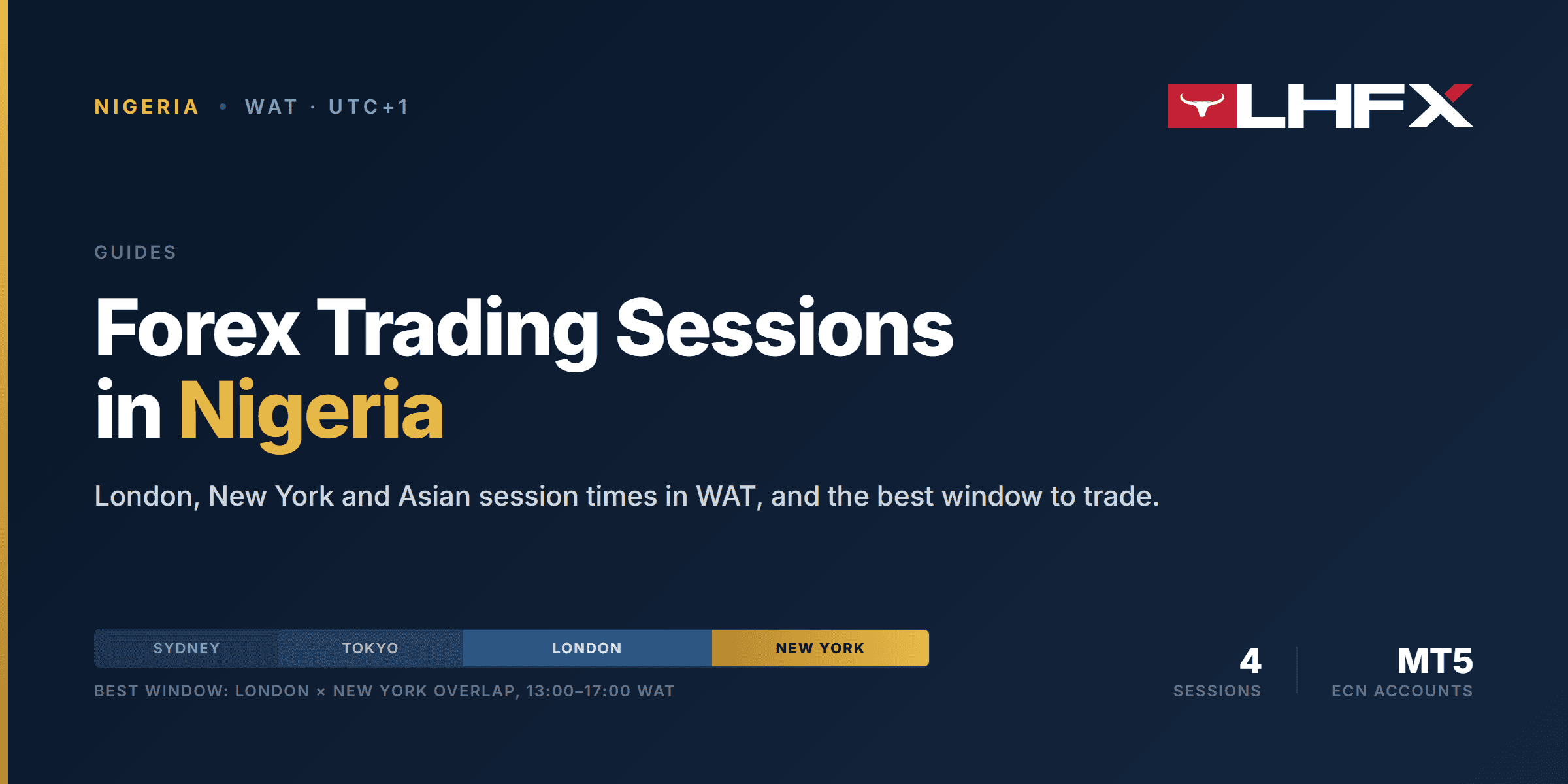
If you trade from Lagos, Abuja, or anywhere else in the country, the forex trading sessions in Nigeria all map back to one clock: West Africa Time (WAT, UTC+1), and Nigeria never changes it. London and New York do, twice a year, so the sessions land at different WAT hours in summer versus winter. That is the one thing most session tables get wrong: they quote a single set of times that is only correct for half the year. This guide gives you the exact open and close times for every session in your local time, which pairs move in each one, and the single best window to trade from Nigeria.
TL;DR
- The forex market opens for the week around 21:00 to 22:00 WAT on Sunday (Sydney) and runs until roughly 22:00 to 23:00 WAT on Friday (New York close).
- London runs 08:00 to 17:00 WAT in summer and 09:00 to 18:00 WAT in winter.
- New York runs 13:00 to 22:00 WAT in summer and 14:00 to 23:00 WAT in winter.
- The best window from Nigeria is the London and New York overlap: 13:00 to 17:00 WAT in summer and 14:00 to 18:00 WAT in winter. This is when volume and movement peak.
- Because Nigeria stays on WAT, you never adjust your clock. The sessions shift against you instead, so check which side of daylight saving you are on before you set alarms.
Forex session times in Nigeria at a glance
Here are the four main sessions in your local time, with separate rows wherever daylight saving moves the window. Trading from South Africa instead? Use our SAST session times guide.
| Session | Opens (WAT) | Closes (WAT) |
|---|---|---|
| Sydney (Australian summer, AEDT) | 21:00 | 06:00 |
| Sydney (Australian winter, AEST) | 22:00 | 07:00 |
| Tokyo (no daylight saving) | 01:00 | 10:00 |
| London (Northern summer, BST) | 08:00 | 17:00 |
| London (Northern winter, GMT) | 09:00 | 18:00 |
| New York (Northern summer, EDT) | 13:00 | 22:00 |
| New York (Northern winter, EST) | 14:00 | 23:00 |
A few notes so these times do not trip you up:
- WAT is fixed. Nigeria does not observe daylight saving, so your clock stays put. Every shift you see above comes from London, New York, or Sydney changing their own clocks.
- Japan is fixed too. Tokyo never changes its clocks either, so the 01:00 to 10:00 WAT window holds all year.
- Sydney shifts on the opposite calendar. Australia's daylight saving runs opposite to the UK and US, so Sydney moves to its earlier window (21:00 to 06:00 WAT) during the Northern winter and its later window (22:00 to 07:00 WAT) during the Northern summer. It is the same session, one hour apart depending on the season.
If you only trade one window, make it the London and New York overlap. The exact WAT hours and which pairs move in each session are covered in the sections below.
The four forex trading sessions in Nigeria time (WAT)
The forex market runs 24 hours a day, five days a week, but it does not move evenly across those hours. Activity clusters into four regional sessions: Sydney, Tokyo, London, and New York. Each one opens as a major financial centre starts its trading day, so liquidity and volatility rise and fall as the sun moves around the world.
Because Nigeria sits on West Africa Time (WAT, UTC+1) and never changes its clocks, your local time stays fixed all year. What moves is the sessions themselves. London and New York shift by one hour twice a year when the UK and US switch daylight saving on and off, so the table below shows a separate summer and winter row for each of them. Sydney and Tokyo are shown as single windows because Japan does not observe daylight saving and the Asian session's timing barely changes for a Nigerian trader.
| Session | Opens (WAT) | Closes (WAT) | Length | Notes |
|---|---|---|---|---|
| Sydney | 22:00 | 07:00 | 9 hours | Kicks off the trading week on Sunday evening WAT. Thin, slow liquidity. |
| Tokyo (Asian) | 01:00 | 10:00 | 9 hours | Fixed all year. Japan does not use daylight saving. |
| London (UK summer, late Mar to late Oct) | 08:00 | 17:00 | 9 hours | Highest-volume session. During UK summer the London clock matches WAT exactly. |
| London (UK winter, late Oct to late Mar) | 09:00 | 18:00 | 9 hours | Same 9-hour session, shifted one hour later because WAT is now ahead of London. |
| New York (US summer, mid-Mar to early Nov) | 13:00 | 22:00 | 9 hours | Overlaps the tail of London. Big moves around US data releases. |
| New York (US winter, early Nov to mid-Mar) | 14:00 | 23:00 | 9 hours | Shifts one hour later in Nigerian time when the US ends daylight saving. |
A few things worth pinning down from that table:
The Asian block (Sydney and Tokyo) sits in the early hours for you. From roughly 22:00 the night before through to about 10:00 WAT, the market is driven out of Sydney and then Tokyo. This is the quietest stretch of the day. Ranges are tighter and moves are smaller, which suits patient range trading more than breakout hunting. The pairs that actually do something here are the yen crosses and the Aussie and Kiwi: USD/JPY, AUD/JPY, EUR/JPY, AUD/USD, and NZD/USD.
London is the heavyweight, and it opens at 08:00 WAT in the UK summer, 09:00 WAT in the UK winter. Whichever half of the year you are in, it is a 9-hour session that closes at 17:00 WAT (summer) or 18:00 WAT (winter). This is where the bulk of daily forex volume goes through, so spreads on the majors tend to be at their tightest and trends have the most fuel behind them. The pairs that come alive are the European majors: EUR/USD, GBP/USD, EUR/GBP, and USD/CHF.
New York opens in your early afternoon and runs into the night. In the US summer it is 13:00 to 22:00 WAT, and in the US winter it shifts to 14:00 to 23:00 WAT. The first few hours matter most, because they overlap with the end of the London session while both markets are open at once. That overlap is the busiest, most tradable window of the day from Nigeria, and it gets its own section below. New York is when USD/CAD, EUR/USD, GBP/USD, and gold (XAU/USD) tend to react hardest, especially around US economic releases.
Only London and New York move against your clock. Tokyo and Sydney stay put through the year because their side of the world either does not run daylight saving or does not affect your WAT window in a way you would notice. So the two sessions you most likely want to trade, London and New York, are also the two that quietly shift by an hour twice a year. The next section breaks down exactly when that happens and how to stay ahead of it, so you are never caught trading yesterday's schedule.
If you want to watch these windows open and close in real time, you can keep a live chart running on the LHFX MT5 platform and simply mark the WAT hours above on your workspace.
London session forex time in Nigeria
The London session runs for nine hours, from 08:00 to 17:00 London local time. That is the session most Nigerian traders care about, because it carries the heaviest volume of the day and sets the tone for the majors.
In Nigeria, the London session opens at 08:00 WAT and closes at 17:00 WAT during the summer, and opens at 09:00 WAT and closes at 18:00 WAT during the winter. Same nine-hour session, one hour later on your clock in winter. The reason it moves is simple: Nigeria stays on WAT all year, while the UK puts its clocks forward in spring and back in autumn, so the London hours drift against your fixed WAT clock twice a year. The full breakdown of when that switch happens and how to stay ahead of it is in the daylight saving section below.
For most of the Nigerian year, an easy rule of thumb is that London kicks off around mid-morning, well after you have had your coffee. If you trade a fixed time each day, check whether the UK is on summer or winter time first, or you will be an hour early or late for the open.
This is also the window where liquidity thickens and spreads on the majors tend to tighten, so it suits pairs that actually move when Europe is at its desk. The ones worth watching in the London session:
- GBP/USD and EUR/USD, the two most active majors of the day
- EUR/GBP, a cleaner European play with less noise from the dollar
- GBP/JPY and EUR/JPY, if you want wider ranges and can handle the extra swing
If you only have a couple of hours to trade, the front half of London tends to give you the cleanest moves, and it runs straight into the New York open, which is where the single best window from Nigeria sits. More on that overlap further down.
New York session forex time in Nigeria
The New York session is the second heavyweight of the trading day, and for a trader in Nigeria it runs late into your evening. Because Nigeria stays on WAT (UTC+1) all year while New York shifts between EDT in summer and EST in winter, the session moves against you by one hour twice a year, exactly like London does.
Here is when the New York session opens and closes in WAT:
| New York session | US summer (EDT) | US winter (EST) |
|---|---|---|
| Opens | 13:00 WAT | 14:00 WAT |
| Closes | 22:00 WAT | 23:00 WAT |
In summer the session is live from early afternoon, so you catch the whole thing after lunch. In winter everything slides an hour later, which means the New York close creeps close to midnight your time. If you trade the US close, note that difference before you sit down.
The two events that actually move your evening
Most of the volatility in this session is not spread evenly. It clusters around US economic data, and two releases matter more than the rest. Both are quoted in the US in Eastern Time, so both land one hour later in WAT during US winter. Getting these wrong by an hour is the difference between being at your screen for the move and missing it.
Non-Farm Payrolls (NFP) comes out at 8:30am ET on the first Friday of most months. In WAT that is:
- 13:30 WAT in US summer (EDT)
- 14:30 WAT in US winter (EST)
NFP is the single biggest scheduled mover for the US dollar. Expect sharp, fast candles on EUR/USD, GBP/USD, USD/JPY and gold (XAU/USD) in the minutes after the print, often with a whippy reversal once the first reaction settles.
The FOMC rate decision and statement lands at 2:00pm ET on the scheduled Fed days, with the press conference following. In WAT that is:
- 19:00 WAT in US summer (EDT)
- 20:00 WAT in US winter (EST)
If you only remember the summer time you will show up an hour early every winter and wonder why the market is quiet. Pin the correct seasonal window before each decision, because the Fed is the one event that can override every other technical read on the chart.
Which pairs to watch in New York
This session is a dollar session. The pairs that move are the ones with USD on one side: EUR/USD, GBP/USD, USD/JPY, USD/CAD and USD/CHF, plus gold, which trades heavily against the dollar and reacts to the same US data. USD/CAD gets an extra kick when US and Canadian data print together, since both economies report on similar calendars.
The first few hours of New York, while London is still open, is where the real range gets built. Once London closes and only New York is left, liquidity thins and moves can get choppy, so many Nigerian traders treat the back half of the evening as a time to manage open positions rather than open fresh ones. You can trade every one of these pairs on MT5 with an ECN account, which matters most during data spikes when execution speed is the whole game.
Asian (Tokyo) session forex time in Nigeria
The Asian session runs on Tokyo's clock, and in Nigeria that means 01:00 to 10:00 WAT. Tokyo is the second-largest forex hub after London, so it sets the tone for the whole Asian window. Sydney technically opens a little earlier and Hong Kong and Singapore trade alongside Tokyo, but if you want one clock to watch, watch Tokyo.
Here is where those hours come from. Tokyo runs on Japan Standard Time (JST), which is UTC+9. Nigeria runs on West Africa Time (WAT), which is UTC+1. That leaves a fixed 8-hour gap between the two, so Tokyo's 09:00 to 18:00 trading window lands at 01:00 to 10:00 for you in Lagos, Abuja, or anywhere else in the country.
Unlike London and New York, this window does not move on you. Neither Nigeria nor Japan observes daylight saving, so both clocks stay put all year. The 01:00 to 10:00 WAT window is the same in January as it is in July. That is one less thing to recalculate every few months.
What actually moves in the Asian session
The Asian session is the quietest of the three. Ranges are tighter, moves are slower, and it suits patient, range-based trading more than breakout hunting. The pairs that come alive are the ones tied to the region:
- USD/JPY, EUR/JPY, and GBP/JPY, driven by Tokyo flows and Bank of Japan headlines
- AUD/USD and NZD/USD, which pick up on Australian and New Zealand data and on Chinese economic releases
- AUD/JPY, a favourite for carry-trade positioning
Majors like EUR/USD and GBP/USD tend to drift in narrow ranges until London wakes up. If you are trading those, the Asian session is often better spent watching levels than forcing entries.
For most Nigerian traders the practical read is simple. If you are up early or trading before work, the Asian window from 01:00 to 10:00 WAT is where the yen and Aussie pairs give you clean, orderly ranges. The bigger moves wait for London later in the morning.
Sydney session forex time in Nigeria
The Sydney session is where the trading day starts. It opens first, before Tokyo, so if you are watching the market roll over from the weekend, this is the one that kicks it off.
Nigeria runs on West Africa Time (WAT), which is UTC+1 all year and never shifts. Australia does observe daylight saving, so Sydney moves against your clock twice a year. That gives you two sets of WAT hours to know:
- Australian summer (roughly October to April): 21:00 to 06:00 WAT
- Australian winter (roughly April to October): 22:00 to 07:00 WAT
So for most of the Nigerian evening and overnight, Sydney is the session in play. If you sit down after dinner in Lagos or Abuja, you are trading into the open rather than the close.
Sydney is the quietest of the four sessions. Ranges are usually tighter, moves are slower, and spreads on some pairs can sit a little wider than they do later in the day. That is not a reason to avoid it, it just changes what you should expect. It suits patient, range-based trading more than chasing big breakouts.
The pairs that actually move during Sydney are the ones tied to the Australian and New Zealand economies. Watch AUD/USD, NZD/USD, AUD/JPY, and AUD/NZD. These are the ones with real liquidity and follow-through at this hour, especially when Australian or New Zealand data drops. Majors like EUR/USD and GBP/USD tend to drift here and only wake up once London approaches.
One practical note: the Sydney open near the start of the week is when the market reacts to anything that happened over the weekend. If price gaps on the Monday open in Nigeria, this is the session where it shows up first, so it is worth a glance even if you plan to trade later in the London window. You can watch all of these pairs live on MT5 with LHFX and set alerts for the levels you care about, so you are not stuck staring at a slow chart all night.
Why your WAT times shift twice a year (London and New York DST)
Here is the part almost every Nigeria session guide gets wrong: it quotes one set of times all year. Those times are only right for half the year.
Nigeria runs on West Africa Time (WAT), which is UTC+1, and it never changes. No spring forward, no fall back. Your clock stays fixed.
London and New York do not. Both observe daylight saving, so twice a year their clocks jump an hour while yours stays put. When their clocks move and yours does not, the sessions land at a different WAT time. You are standing still and the market walks toward you or away from you.
The two clocks that move:
- London. British Summer Time starts on the last Sunday of March and ends on the last Sunday of October. In summer, London is UTC+1, the same as Lagos, so the London open lands at 8am WAT. In winter, London drops to UTC+0, and the same open slides to 9am WAT.
- New York. US daylight time starts on the second Sunday of March and ends on the first Sunday of November. In summer, New York is UTC-4 and its open lands at 1pm WAT. In winter, New York is UTC-5 and the open slides to 2pm WAT.
So in the northern-hemisphere summer, both sessions open an hour earlier in WAT than they do in winter. That one hour also moves the London and New York overlap, the busiest window you can trade from Nigeria, which is why the exact overlap hours in this guide are given as separate summer and winter rows rather than a single line.
The gap most guides never mention. The UK and US do not switch on the same day. The US springs forward on the second Sunday of March, but the UK waits until the last Sunday. For those two-ish weeks in March, and again for the week between the US and UK fall-back dates around late October and early November, London and New York are briefly one hour further apart than usual. During that gap the New York open and the London and New York overlap sit an hour off their normal WAT slot. If your trade timing suddenly feels off by an hour in mid-March or early November, this is why. Nothing is broken, the two clocks are just out of step for a few days.
The practical takeaway: check whether London and New York are on summer or winter time before you set alarms, and use the summer or winter row in the table above rather than memorising a single set of hours. Your WAT clock is the fixed reference. Everything else moves around it.
The best time to trade forex in Nigeria: the London and New York overlap
If you only trade one window a day, make it this one. The best time to trade forex in Nigeria is the stretch when London and New York are both open at the same time. That is when the two largest pools of liquidity in the market are live together, spreads on the majors are at their tightest, and price moves enough to actually be worth your time.
Because Nigeria stays on WAT all year while London and New York both shift for daylight saving, the overlap lands at slightly different WAT hours depending on the season. Here is the window in your local time.
| Season | London and New York overlap (WAT) | Length |
|---|---|---|
| Winter (roughly late October to late March) | 14:00 to 18:00 | 4 hours |
| Summer (roughly late March to late October) | 13:00 to 17:00 | 4 hours |
The window opens when New York opens and closes when London closes:
- New York opens at 8:00 in New York, which is 14:00 WAT in winter and 13:00 WAT in summer.
- London closes at 17:00 London time, which is 18:00 WAT in winter and 17:00 WAT in summer.
Line those two up and you get the same four hours either way. The whole block just slides back an hour when the clocks change abroad, because your WAT clock never moves and theirs does.
Which pairs actually move in this window
The overlap rewards pairs that carry both a European and a US leg, since traders on both continents are pricing them at once. Focus on EUR/USD, GBP/USD and USD/CHF where the London flow meets New York, plus USD/CAD, which only really wakes up once North America is at its desk. These are the pairs where tight spreads and real movement show up in the same four hours, so your setups fill cleanly and your stops are not eaten by a wide spread.
A practical note for trading from Nigeria: this window falls in the afternoon and early evening WAT, after most working hours. If you hold a day job, you can catch the busiest part of the trading day without being up at 3am. Tight spreads matter most here, because the overlap is exactly when you are paying the spread on the majors most often, so an ECN account on MT5 is worth having if you plan to trade this window regularly.
If you trade nothing else, block out these four hours, watch the majors above, and let the quieter parts of the day go.
Trading the sessions with LHFX
Once you know which session you want to trade in WAT, the rest is setup. With LHFX you trade on MetaTrader 5, fund your ECN account with a card or crypto, and get the same forex majors plus CFDs on indices, commodities, and crypto in one place. That last part matters for session planning: if the London and New York overlap is quiet on your pairs one afternoon, gold and the major indices are usually moving in the same window, so you are not stuck waiting. If you are new to the mechanics, the forex trading in Nigeria guide walks through funding, spreads, and getting set up locally, and our guide to forex brokers in Nigeria with a low minimum deposit compares your options.
One setup detail trips up a lot of Nigerian traders. MT5 charts run on the broker's server time, not on your WAT clock. So the candle that opens the London session on your screen will not read 09:00 or 10:00, it reads whatever the server clock shows. Check your server time once by hovering the clock in the Market Watch window, work out the fixed offset from WAT, and write it down. From then on you can glance at any candle and know exactly which session it belongs to without doing the maths every time.
Keep in mind that the offset shifts when London and New York change clocks. Nigeria stays on WAT all year, so re-check your server-to-WAT offset around late March and late October and adjust the number you wrote down.
Pick the session that fits your schedule, size your risk for the volatility that session brings, and let the overlap window do the heavy lifting. If you want to try it on a live ECN account, open an account with LHFX and set your server offset before your first trade.
Frequently asked questions
What time does the forex market open in Nigeria?
The market opens on Sunday night in Nigeria, around 21:00 to 22:00 WAT, when Sydney starts the new trading week. From there it runs 24 hours a day and closes on Friday night, around 22:00 to 23:00 WAT, when New York wraps up. Nigeria stays on WAT all year, so the only reason those open and close times drift by an hour is the daylight-saving change in Sydney and New York, not anything on your side.
What time is the London session in Nigeria?
London runs for nine hours: 09:00 to 18:00 WAT in winter and 08:00 to 17:00 WAT in summer. The one-hour shift happens because London moves its clocks for daylight saving while Nigeria does not, so the whole session slides an hour earlier from late March to late October.
What time is the New York session in Nigeria?
New York runs from 14:00 to 23:00 WAT in winter and 13:00 to 22:00 WAT in summer. Same cause as London: New York changes its clocks twice a year and WAT holds steady, so the session moves against you an hour each way with the seasons.
What time does the Asian market open in Nigeria?
The Asian session opens late evening Nigeria time. Sydney gets things going around 21:00 to 22:00 WAT, and Tokyo joins near 01:00 WAT. The session winds down by about 10:00 WAT. Japan does not observe daylight saving, so the Tokyo window against WAT stays fixed all year.
When is the best time to trade forex in Nigeria?
The London and New York overlap, when the two biggest sessions are open at the same time. From Nigeria that is a four-hour window: 14:00 to 18:00 WAT in winter and 13:00 to 17:00 WAT in summer. Liquidity is deepest and movement is largest here, especially on EUR/USD and GBP/USD, which is why most Nigeria-based traders build their day around it.
What are the four sessions of forex?
Sydney, Tokyo, London, and New York. They open in sequence around the clock, which is what lets forex trade 24 hours on weekdays. Sydney and Tokyo together are what most traders call the Asian session, then London and New York follow.
What is the 5-3-1 rule in forex?
The 5-3-1 rule is a focus method for newer traders: pick 5 currency pairs to learn well, 3 strategies to master, and 1 time of day to trade consistently. For a trader in Nigeria, that one time slot is usually the London and New York overlap, since that is when the pairs you are watching actually move.