هذا المقال غير متاح بعد باللغة العربية. يتم عرض النسخة الإنجليزية.
How Is Forex Trading Taxed in South Africa?

How Is Forex Trading Taxed in South Africa? SARS Rules Explained
Here is the question every South African trader eventually searches, usually after their first profitable month: do I actually have to pay tax on this?
Yes. And the way it is taxed surprises most people, because forex profits do not get the friendly capital gains treatment that long-term investments enjoy. They get taxed like a salary.
This guide explains how SARS treats forex and CFD trading profits, what you can deduct, what records to keep, and the mistakes that turn a good trading year into a bad tax season.
Do Forex Traders Pay Tax in South Africa?
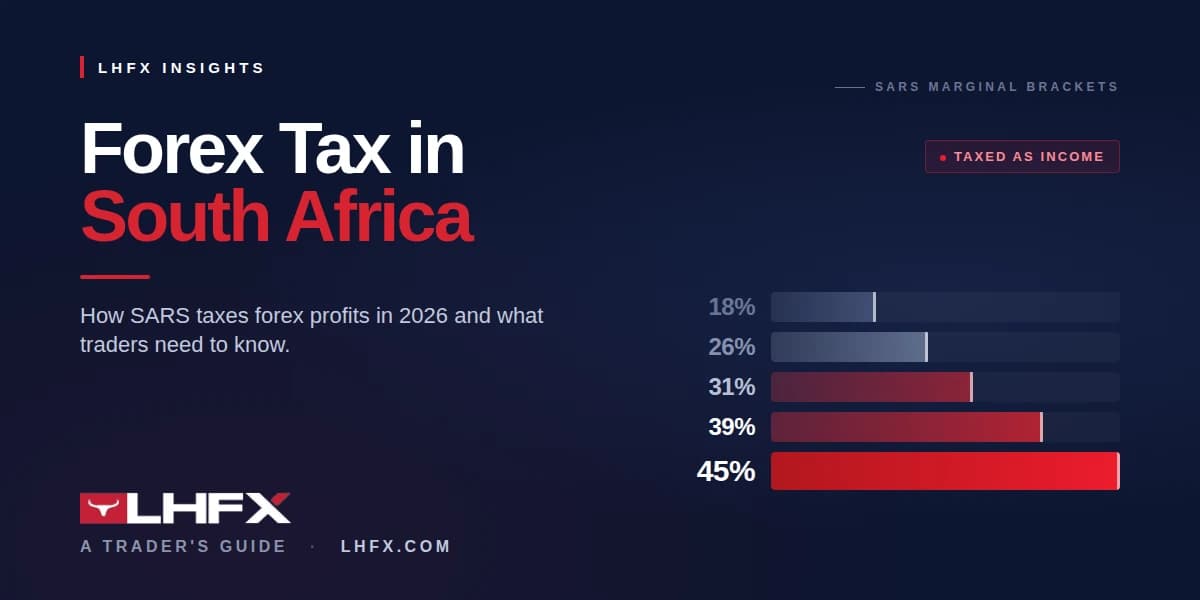
Yes. SARS treats forex and CFD trading profits as ordinary income, not capital gains. Your net trading profit is added to your other income for the year and taxed at your marginal rate, which runs from 18% to 45% depending on your total taxable income.
South Africa taxes residents on worldwide income. Profits made through an offshore broker in Mauritius, Cyprus, or anywhere else are just as taxable as profits made through a broker in Rosebank. There is no exemption for offshore accounts.
If trading becomes a meaningful income stream, you will likely also need to register as a provisional taxpayer and pay tax twice a year. Trading losses can generally be offset against other income, genuine trading expenses are deductible, and SARS can ask for supporting records up to five years back.
Revenue vs Capital: The Distinction That Decides Everything
South African tax law splits gains into two categories, and which one applies changes your tax bill significantly.
Capital gains apply when you buy an asset intending to hold it long-term as an investment. Capital gains tax (CGT) has real advantages: the first R40,000 of gains each year is excluded, only 40% of the remaining gain counts as taxable income, and the maximum effective rate works out to around 18%.
Ordinary income (revenue) applies when you buy and sell with the intention of profiting from price movements. 100% of the profit is taxable at up to 45%.
The deciding factor is intention, and SARS looks at what you actually did. Frequent trades, short holding periods, leverage, and a systematic profit-seeking pattern all point to revenue treatment.
For forex and CFD trading, this question is essentially settled. Opening and closing leveraged positions to profit from short-term price moves is revenue by nature. Holding a position for three weeks instead of three hours does not change the analysis. The question is not "how do I get my forex profits taxed as capital gains" — you almost certainly cannot. The question is how to handle income treatment correctly.
What You Will Actually Pay: 2026/27 Tax Brackets
The key word is marginal. Your trading profit stacks on top of your other income for the year and gets taxed at whatever rate that band falls in.
Taxable income (2026/27) | Marginal rate |
|---|---|
R0 to R245,100 | 18% |
R245,101 to R381,200 | 26% |
R381,201 to R528,000 | 31% |
R528,001 to R731,400 | 36% |
R731,401 to R1,103,300 | 39% |
R1,103,301 to R1,654,800 | 41% |
R1,654,801 and above | 45% |
The primary rebate for the 2026/27 year is R17,820, meaning you pay no tax at all below roughly R99,000 of total taxable income if you are under 65.
Example: Thandi, part-time trader. Thandi earns a salary of R420,000 and made a net trading profit of R80,000. The R80,000 lands on top of her salary in her marginal bracket and gets taxed at 31%. Her trading profit costs her roughly R24,800 in tax.
Example: Sello, full-time trader. Sello has no salary. Trading is his only income and he netted R300,000. The brackets fill from the bottom: 18% on the first slice, 26% on the next, 31% on the rest, less the primary rebate. His effective rate is well below his marginal rate, which is one of the few advantages of trading being your only income.
The practical takeaway: before the tax year ends, work out your marginal rate and put that percentage of every withdrawal into a separate account the day it lands.
Provisional Tax: The Bit Nobody Warns You About
PAYE earners are used to tax being handled automatically. Trading income changes that.
If you earn income outside PAYE above the relevant thresholds, SARS requires you to register as a provisional taxpayer. That means:
An estimated payment in August (first period).
A second estimated payment in February (second period).
An optional top-up payment to avoid interest on any shortfall.
Underestimating triggers penalties. Missing the deadlines altogether triggers worse. If your trading has moved from hobby money to real money this year, registering for provisional tax is the most important admin task on your list. A tax practitioner handles the registration and estimates for a modest fee, which is cheap insurance against SARS interest charges.
What You Can Deduct
Because trading profits are treated as revenue, the expenses you incur to produce them are generally deductible. Legitimate deductions for an active trader include:
Charting and data subscriptions (TradingView, Bloomberg feeds, VPS hosting for your MT5 terminal).
A proportionate share of your internet and phone costs.
Home office costs, if you trade from a dedicated space and meet SARS's strict home office requirements.
Bank and payment fees on funding and withdrawing your trading account.
Interest on borrowings used for trading (get specific advice here).
Keep invoices for everything. A deduction without a paper trail is a deduction SARS disallows on review. And be honest about apportionment: if you use your laptop 20% for trading, you claim 20%, not the whole device.
Can You Reduce Your Forex Tax Legally?
You cannot avoid forex tax. SARS taxes SA residents on worldwide income and receives automatic account information from foreign financial institutions under the Common Reporting Standard. Your own bank records every deposit and withdrawal too. There is no viable offshore workaround.
You can legitimately reduce the bill:
Deduct every genuine trading expense — subscriptions, data, proportionate home office costs, payment fees. These reduce your net taxable profit directly.
Offset trading losses against other income in the same year where applicable.
Register as a provisional taxpayer early and pay on time, so you do not accumulate interest on late payments.
Consider a company structure once profits are consistent and you are reinvesting most of them — but model the numbers with an accountant first. The flat 27% corporate rate sounds attractive until you factor in dividends tax and extraction costs.
Declare everything. The tax on honest profits is always cheaper than the penalties, interest, and understatement charges on hidden ones.
Trading Losses: Useful, With a Catch
A net loss for the year is generally deductible against your other income, which softens the blow. A R50,000 trading loss against a R500,000 salary reduces your taxable income by R50,000.
The catch is ring-fencing. Section 20A of the Income Tax Act allows SARS to ring-fence losses from "suspect trades" for individuals in the top tax bracket who produce trading losses in at least three of five consecutive years. Ring-fenced losses can only be offset against future profits from the same activity, not against salary or other income.
For most retail traders this rule never comes into play. If you are a high earner posting trading losses for the third year running, get advice before filing.
Record Keeping: What SARS Expects
Every trade should be recoverable in rand terms. In practice, that means keeping:
Your full broker statements for the tax year (MT5 exports these in a few clicks from the account history tab).
Deposit and withdrawal records with dates and ZAR values.
The exchange rate basis you used to convert USD profits to ZAR — using SARS published rates or your bank's actual conversion rate consistently is the safe approach.
Invoices for every expense you claim.
Do this monthly, not in a panic the week before filing. A simple spreadsheet with one row per month covering net profit, withdrawals, and expenses will carry most retail traders through filing season without stress.
Should You Trade Through a Company?
Once profits get serious, traders ask about company structures. The honest picture:
A company pays a flat 27% corporate rate on profits, which looks better than a 41% or 45% marginal rate. But extracting money from the company costs you again: salaries are taxed in your hands at marginal rates, and dividends carry 20% dividends tax. Stack those layers and the combined effective rate on extracted profits often lands close to the top personal rates anyway, with added accounting fees and compliance admin.
A company starts making sense when you are consistently profitable at scale, reinvesting most profits rather than drawing them out, or building a broader trading business. For a retail trader netting a few hundred thousand rand a year and spending it, personal tax with proper deductions is usually simpler and comparable in cost. Model your specific numbers with an accountant before restructuring.
Common Tax Mistakes Traders Make
Spending gross profits. Your account balance is not all yours. Put your marginal rate aside in a separate account every time you withdraw.
Ignoring provisional tax. Waiting for the annual return when you owed estimates in August and February means interest and penalties on top of the underlying tax.
Assuming offshore means invisible. CRS reporting and your own bank records make this the easiest mistake for SARS to catch. Declare everything.
Claiming everything as a deduction. The full laptop, the full internet bill, a "research" trip. Aggressive claims invite reviews, and reviews look at the whole return.
Leaving records until filing season. Reconstructing a year of trades across deposits, withdrawals, and exchange rates in one weekend produces errors in both directions.
Planning around capital gains treatment. Hoping CFD profits qualify for the R40,000 exclusion and 18% effective rate. They will not. Plan around income treatment from your first trade.
Where LHFX Fits
LHFX SA (PTY) Ltd is regulated by the FSCA under FSP licence 52816, with offices in Rosebank, Johannesburg. LHFX does not withhold tax on withdrawals and does not report trading activity to SARS on your behalf. Declaring profits is your responsibility, every year.
A few platform features that make the admin easier:
MT5 account statements export your complete trade history — entry, exit, profit and loss per position — in a few clicks. That is the core document your tax return is built from.
Withdrawals process in under 12 minutes on average with zero fees, so moving your tax set-aside out of the trading account the day you take profits is straightforward.
Zero deposit and withdrawal fees keep your funding records clean and simple to reconcile at year end.
Open a free demo account to get familiar with the platform before committing real money, or open a live account from $10 (around R180).
Frequently Asked Questions
Do you pay tax on forex trading in South Africa?
Yes. SARS treats forex and CFD trading profits as ordinary income, taxed at your marginal rate from 18% to 45%. South African residents are taxed on worldwide income, so profits from offshore brokers count too.
Is forex trading taxed as income or capital gains in South Africa?
Almost always income. CFD and leveraged forex trading is profit-seeking by nature, which makes it revenue in SARS's view. The capital gains regime, with its R40,000 exclusion and lower effective rates, applies to long-term investments, not active trading.
How much tax do forex traders pay in South Africa?
It depends on your total taxable income, because forex profit stacks on top of everything else you earn. On top of a R420,000 salary, expect around 31%. On top of a R800,000 salary, expect 39% to 41%. If trading is your only income, the brackets fill from the bottom and your effective rate is lower.
Do I need to register as a provisional taxpayer?
If trading income above the relevant thresholds flows to you outside PAYE, almost certainly yes. Provisional taxpayers submit estimates and pay in August and February. Register before the first deadline, not after.
Can I deduct trading losses in South Africa?
Generally yes, against your other income in the same year. The exception is ring-fencing under Section 20A for top-bracket taxpayers with repeated losses across multiple years, where losses can only carry forward against future trading profits.
What records do I need to keep for SARS?
Full broker statements for the tax year, deposit and withdrawal records with ZAR values, the exchange rates used to convert foreign currency profits, and invoices for every expense you deduct. SARS can request supporting documents up to five years back.
Does SARS know about my offshore trading account?
Increasingly, yes. South Africa participates in the Common Reporting Standard, under which foreign financial institutions automatically report account information to tax authorities. Your local bank also records every transfer. Declare all income.
Will LHFX deduct tax from my withdrawals?
No. LHFX processes withdrawals in full without withholding. Declaring and paying tax to SARS is your responsibility.
Risk warning: CFDs are complex instruments and come with a high risk of losing money rapidly due to leverage. Consider whether you understand how CFDs work and whether you can afford to take the high risk of losing your money. Past performance is not indicative of future results. This article is for informational purposes only and does not constitute financial, investment, or tax advice. Tax outcomes depend on individual circumstances and legislation changes annually. Consult a registered tax practitioner before making any decisions.