Hierdie artikel is nog nie beskikbaar in Afrikaans nie. Engels weergawe word getoon.
HFX Trading: What It Actually Is, Is It Legit, and How to Start

What HFX trading actually is (and what it is not)
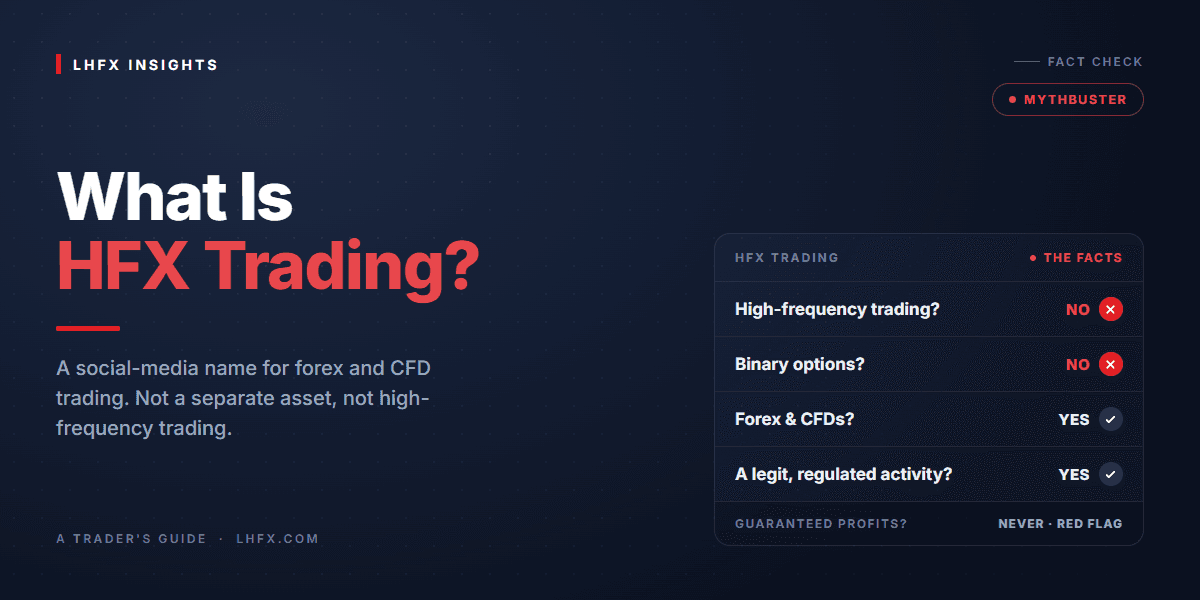
Here is the plain answer most search results dance around: HFX trading is a nickname for trading forex and CFDs on margin. That is it. It is not a separate asset class, not a special product, and not its own exchange. When you understand "what is HFX," you already understand the whole thing, because it is the same currency-pair and CFD trading that has existed for decades, just under a newer label.
The label itself came from social media. The term was popularized on Instagram, TikTok and YouTube, largely by signal sellers and paid-mentorship promoters who repackaged ordinary retail forex and CFD trading as something that sounds proprietary and exclusive. "HFX" feels like an insider system worth paying for. The underlying activity is the same buying and selling of currency pairs that any regulated broker has always offered.
Two myths dominate the top results, and both are wrong.
| Claim you will see | Reality |
|---|---|
| HFX = high-frequency trading | High-frequency trading vs HFX are not the same thing. High-frequency trading is institutional algorithmic execution that fires orders in microseconds using colocated servers. The social-media "HFX" is manual retail trading done from a phone or laptop. |
| HFX = binary options | Binary options are fixed-payout bets on a yes/no outcome. HFX trading is standard margin trading of forex and CFDs, where your profit or loss moves with the price and the size of your position. |
There is also a brand collision worth clearing up. Search for the term and you will also land on an unrelated broker that happens to use the HFX name, plus a UPCOM-listed stock with the ticker HFX. Neither of those is what people mean when they say "HFX trading" on social media. The ticker is a single company's equity. The same-named broker is just a coincidence of branding.
So here is the honest frame for the rest of this article, the one the listicles never set. HFX trading explained simply: when someone says they trade HFX, they almost always mean opening positions on currency pairs and CFDs through a broker, on a platform such as MetaTrader 5. That is the real product. It carries real risk, since leveraged forex and CFD trading can lose money quickly, and we will cover exactly how that works and how to start conservatively in the sections below.
How HFX trading really works
Once you strip away the social-media branding, hfx trading is forex and CFD trading. You speculate on the price direction of a currency pair without ever owning the underlying currency. Take EUR/USD, the most-traded pair in the world. If you think the euro will strengthen against the dollar, you buy. If you think it will weaken, you sell. You never take delivery of euros or dollars. You open a position, the price moves, and you close it for a profit or a loss based on the difference.
Pips, lots and spread
A pip is the standard unit of price movement. On EUR/USD it is the fourth decimal place, so a move from 1.0850 to 1.0851 is one pip. Position size is measured in lots: one standard lot is 100,000 units of the base currency, where one pip is worth about $10. Trade a 0.10 lot and that pip is worth about $1.
Spreads are the gap between the buy price and the sell price. On a raw account at LHFX, spreads start from 0.0 pips on major pairs like EUR/USD, so the price you can buy at and the price you can sell at sit right on top of each other.
Leverage and margin
Leverage lets a small deposit control a larger position. With leverage up to 1:500, a $200 margin deposit can control a position worth $100,000. That magnifies gains, and it magnifies losses by exactly the same factor. A move that would earn you 2% unleveraged can wipe out your margin when amplified 500 times. Leverage cuts both ways, and on a leveraged position you can lose more quickly than you expect. This is the single biggest reason most retail forex traders lose money.
How your order reaches the market
Execution model matters. LHFX runs STP/ECN execution, which means your order is routed straight through to market liquidity. The broker is not on the other side of your trade and does not profit when you lose. You get the price the market is showing, with no dealing desk in between.
The costs that decide profitability
Two costs determine whether you actually come out ahead: spread and commission. On a raw-spread account you pay tight spreads from 0.0 pips plus a flat $3 per side, so $6 on the full round trip of a standard lot.
Here is what one round-trip EUR/USD trade looks like end to end:
| Step | Detail |
|---|---|
| Buy 1 lot EUR/USD | Entry at 1.0850, $3 commission charged |
| Price moves | EUR/USD rises to 1.0860 (+10 pips, about $100) |
| Sell to close | Exit at 1.0860, $3 commission charged |
| Gross result | +$100 |
| Total cost | $6 commission plus the spread paid at entry |
| Net result | About $94 |
The cost is deducted at entry and exit, so you start every trade slightly behind and the market has to move in your favour before you break even. Knowing your exact cost per trade is what separates traders who plan from traders who guess.
Is HFX trading legit, or a scam?
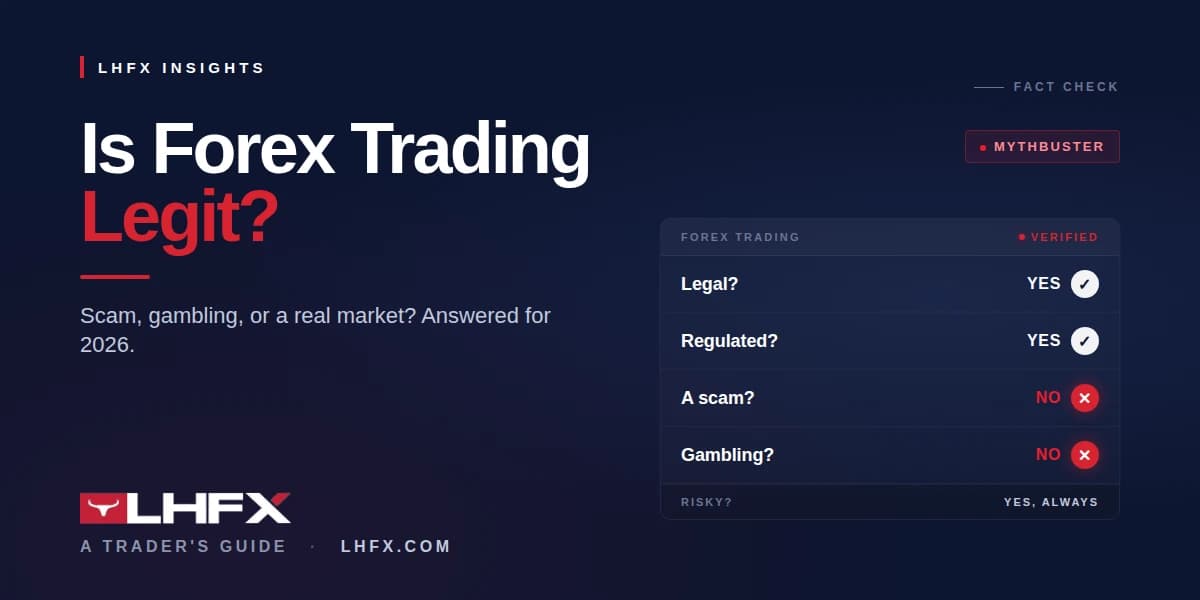
Here is the straight answer: the trading itself is legitimate. HFX trading is just retail forex and CFD trading, and forex and CFDs are regulated activities in many regions around the world. The scam is rarely the trading. It is almost always who is selling it to you.
That distinction matters, because the question "is HFX trading legit" usually comes from someone who saw the term in a paid signal group, not from someone reading a regulator's website. The trading is real. The packaging is where the problems start.
The signal-seller and mentorship pattern
Most "HFX gurus" do not make their money trading. They make it selling access to you. The pattern is consistent enough that you can spot it in seconds:
- Paid Telegram or Discord "HFX trading signals" you pay monthly for
- "Copy my trades" offers and screenshots of profits with no verified statement
- Luxury-lifestyle marketing: rented cars, watches, hotel suites
- Recruitment incentives, where you earn for bringing in more people
If the main product is a course, a signal subscription, or a referral chain rather than transparent market access, treat it as marketing, not mentorship. Real traders sharing what they do is fine. Anyone whose income depends on your monthly fee has every reason to keep you subscribed regardless of your results.
Red flags in a so-called broker
The other half of an HFX trading scam is the fake or unaccountable "broker." Watch for these:
| Red flag | What it really means |
|---|---|
| Guaranteed returns | No legitimate broker promises profit. Markets do not work that way. |
| Withdrawal problems | Deposits clear instantly, withdrawals stall or get "fees." |
| Pressure to deposit more | Urgency and bonuses to add funds are a manipulation tactic. |
| Unverifiable regulation | A licence number you cannot confirm on the regulator's own register. |
| "Account manager" trading for you | A stranger trading your money is how balances disappear. |
The honest statistic
A large majority of retail CFD accounts lose money over time. That is the published reality across regulated brokers, and it is the most useful frame you have: if most accounts lose, then anyone promising you guaranteed profit is, by definition, lying. Treat a guarantee as disqualifying on its own.
How to verify legitimacy yourself
You do not need to trust anyone. You can check:
- Confirm the regulation. Find the licence number and look it up on the regulator's official register, not the broker's own page.
- Read the risk disclosure. A legitimate broker states plainly that you can lose money. Vagueness here is a warning.
- Test a withdrawal early. Deposit a small amount, trade a little, then withdraw. If that is smooth, the plumbing works.
- Demand transparent pricing. You should see exactly what a spread and commission cost before you trade, not after.
Leveraged forex and CFD trading carries real risk, and nobody can promise you will profit. That honesty is the point. Any HFX guru who guarantees gains is not the exception to the rule. They are the warning sign.
What to look for in a real HFX broker and platform
Since HFX trading is just forex and CFD trading, the thing you are actually choosing is a broker. The signal sellers and mentorship promoters rarely tell you this, because the broker is where your money lives and where the real questions get answered. Here is what separates a serious broker from one you should walk away from.
Execution. You want STP/ECN routing that sends your orders to market liquidity, not a desk that profits when you lose. A real ECN broker is straightforward about how orders are filled. If a broker is vague about execution or cannot explain how your trade reaches the market, treat that as a reason to stop.
Pricing transparency. The honest model is raw spreads plus a flat, disclosed commission. Raw spreads from 0.0 pips with a commission of $3 per side is transparent: you can see exactly what you pay. Compare that to brokers that hide their fee inside an artificially wide spread, where the real cost is buried and harder to track over many trades.
Platform. MetaTrader 5 is the practical standard for HFX-style forex and CFD trading. It handles charting, the full range of order types, and automated strategies through expert advisors. A good hfx trading platform also gives you breadth: at LHFX that means 41 forex pairs and 150+ instruments across markets, so you are not boxed into a handful of products.
Account access. For beginners, a low barrier matters. A $10 minimum deposit means you can fund a live account without committing a meaningful sum while you are still learning, and a free demo lets you practice with zero money at risk first.
Non-negotiables. Regulation, segregated client funds, clear withdrawal terms, and a genuine risk disclosure are not optional. Leveraged forex and CFD trading carries a high risk of losing money, and any broker worth trusting states that plainly rather than implying easy profits.
Here is how those criteria line up at LHFX, offered as one option that meets them, not as a recommendation to skip your own checks:
| What to check | LHFX |
|---|---|
| Execution | STP/ECN to market liquidity |
| Spreads | Raw, from 0.0 pips |
| Commission | $3 per side, flat and disclosed |
| Platform | MetaTrader 5 |
| Instruments | 41 forex pairs, 150+ total |
| Minimum deposit | $10 |
| Demo account | Free, available before funding |
Among hfx brokers, these are the specifics you should be able to verify for any name you consider. If a broker will not put its execution model, spreads, and commission in writing, that absence is your answer. You can open a demo and test execution and pricing yourself before any money moves, which is exactly where a cautious beginner should start.
HFX trading for beginners: a realistic way to start
If you searched for "hfx trading for beginners" or "hfx trading for dummies," here is the honest version. HFX is just forex and CFD trading, so the path to learning it is the same path serious traders have always used. There are no shortcuts, but there is a sensible order to do things in. Here is how to start HFX trading without lighting your money on fire in week one.
Step 1: Open a free demo account. A demo account lets you trade virtual money on live market prices. Use it until your process produces consistent results, not one lucky week. Luck and skill look identical over a handful of trades. They stop looking identical over a few hundred.
Step 2: Learn the mechanics on demo. Before real money is involved, get fluent in the basics: placing a market order, placing a limit order, reading a price chart, and setting both a stop loss and a take profit on every position. On MetaTrader 5 these are a few clicks. Knowing exactly where your exit sits before you enter is the habit that separates traders from gamblers.
Step 3: Fund small. People ask "is $100 enough to start forex?" The honest answer: yes, you can start with very little. LHFX has a $10 minimum deposit. But understand the trade-off. A small account earns small absolute returns. A good month of disciplined trading on $100 is measured in single or low double-digit dollars, not life-changing money. The percentage risk on a small account is identical to the risk on a large one. Start small to learn cheaply, not to get rich fast.
Step 4: Make risk management the core skill. This is the actual job.
| Rule | Why it matters |
|---|---|
| Risk a small fixed percentage per trade | Caps any single loss so one bad call cannot end your account |
| Always use a stop loss | Removes emotion from the exit decision |
| Never add to a losing position | Averaging down turns a small loss into a large one |
Leverage up to 1:500 is available, which amplifies both gains and losses. Used carelessly it accelerates how fast a small account goes to zero.
Step 5: Keep a trading journal and ignore the shortcuts. Log every trade: your reason for entering, your stop, your exit, and what you would do differently. Review it weekly. And ignore the signal groups and "mentors" selling a fast track. The skill is built by your own reviewed repetitions, not by paying someone for theirs.
Set realistic expectations. Trading is a skill that takes time. Losses are a normal, permanent part of it, even for profitable traders. Leveraged forex and CFD trading is high-risk and most beginners lose money early. Consistency over many trades beats big swings every time.
The real risks of leveraged HFX trading
Leverage is the single feature that makes HFX trading exciting and dangerous in equal measure. At 1:500, a $200 deposit controls a $100,000 position. The same multiplier that turns a 0.2% favourable move into a doubled account turns a 0.2% adverse move into a wiped-out account. Leverage risk is symmetric: it scales losses exactly as fast as gains.
Here is how a small move hits a small account at different leverage levels on a $500 balance:
| Leverage | Position size | 0.5% adverse move | % of account lost |
|---|---|---|---|
| 1:10 | $5,000 | $25 | 5% |
| 1:100 | $50,000 | $250 | 50% |
| 1:500 | $250,000 | $1,250 | account wiped, margin call |
Margin calls and stop-outs. Your broker requires a minimum margin to keep positions open. When losses drag your equity below that level, you get a margin call, and if equity keeps falling, the platform automatically closes positions at a stop-out level to protect the balance. You do not choose when this happens. The market does.
Volatility, gaps and slippage. Prices do not move in smooth steps. Around news releases or at the weekend open, a pair can gap straight through your stop-loss, filling you at a worse price than you set. This is a core part of forex risk management to understand: a stop-loss limits risk, it does not guarantee an exact exit. CFD risk works the same way across indices, metals, and crypto.
Emotional and behavioural risk. Most accounts are not destroyed by one bad trade. They are bled out by overtrading, by revenge trading after a loss, and by chasing the next "high-probability" call from a signal group. The HFX trading risks that hurt most are psychological, and no platform setting fixes them.
The honest part. The majority of retail CFD and forex accounts lose money. Only trade capital you can afford to lose entirely, and treat this as education, not financial advice. No strategy, broker, or mentor can remove leverage risk. Anyone who tells you otherwise is the exact red flag we covered earlier.
HFX trading FAQ
What is HFX trading?
HFX trading is ordinary retail forex and CFD trading, marketed under a different name. The term spread on Instagram, TikTok, and YouTube, mostly through signal sellers and mentorship-course promoters, so it sounds like a separate product when it is not. It is not high-frequency trading (the institutional, server-colocated kind), and it is not binary options. When someone says they trade HFX, they mean buying and selling currency pairs and CFDs through a broker. For the full definition above, including where the high-frequency and binary-options confusion comes from, read the opening section.
Where can I trade HFX?
You trade HFX the same place you trade any forex or CFD: through a regulated broker on a real trading platform. At LHFX that platform is MetaTrader 5, with raw spreads from 0.0 pips, commission of $3 per side, leverage up to 1:500, and access to 41 forex pairs and 150+ instruments. Skip anyone selling an "HFX platform" as if it were a unique product; the platform is MT5, and the asset is forex. Open a free demo account to place trades in live market conditions before you risk anything.
Is $100 enough to start forex?
Yes, in the sense that the LHFX minimum deposit is $10, so $100 clears the threshold comfortably. Whether it is enough to trade well is a different question. With limited capital you have to keep position sizes small and accept that returns on a small balance are small in absolute terms. Leverage can amplify both gains and losses, and most retail traders lose money, so size every trade against what you can afford to lose. The sensible path is to learn on a free demo account first, then fund a small live balance once you can manage risk consistently.
What trading platform can I use for HFX?
MetaTrader 5. There is no separate "HFX platform"; that framing comes from marketers, not from the market. MT5 gives you charting, technical indicators, automated strategies through Expert Advisors, and order types for both fast intraday trading and longer holds. LHFX runs MT5 with STP/ECN execution, so your orders are routed to the market rather than filled against an in-house book. You can practise the full workflow on a demo account before committing real funds.