Hierdie artikel is nog nie beskikbaar in Afrikaans nie. Engels weergawe word getoon.
Is Forex Trading Legit? (Or a Scam, Gambling, Legal Questions Answered)

If you typed "is forex trading legit" into Google, you are doing the right thing. You are skeptical, and you should be. The currency market is real and so are the brokers who serve it, but the space is crowded with signal sellers, fake "account managers" and unregulated brokers who make withdrawals disappear. This article separates the two with no spin.
TL;DR
- Forex is legitimate. It is the largest financial market in the world. Banks, hedge funds, corporations and individuals all participate. Regulated brokers operate under the same supervision as other financial firms.
- Forex is not gambling, but it is high-risk speculation. Skill, planning and risk management create an edge. Treating it like a casino guarantees you lose.
- It is legal in South Africa (regulated by the FSCA) and in Nigeria (the SEC publicly acknowledges retail forex; there is no law against trading with international brokers).
- Most retail traders lose money. Industry data from regulated brokers shows roughly 70 to 80 percent of retail clients are net losers over a given period. The way to avoid that group is realistic capital, low leverage, a written plan and a demo first.
- Scams exist, but they have predictable patterns. "Guaranteed returns", account managers, signal groups, and unregulated brokers are the four big traps.
Is forex trading legit?
Yes. Foreign exchange is the world''s largest market by volume. The Bank for International Settlements (BIS) triennial survey put global daily turnover at over $7 trillion. Central banks, commercial banks, multinational companies hedging revenue, hedge funds, and retail traders all transact on the same currency markets every business day. None of that is a scheme. Currency conversion is the plumbing of global trade.
Retail forex (the kind you do from a laptop with a broker account) is a smaller slice of that total, but it operates under the same instruments. The EUR/USD price on your platform is sourced from interbank liquidity. The trade is real.
The "is forex a scam" reputation does not come from the market. It comes from the marketing layer around it. Unregulated brokers, signal sellers and fake mentors prey on people who do not yet know how to verify a broker''s license. The market is legitimate. Some of the people advertising it on social media are not.
Is forex trading gambling?
No, but the comparison is fair enough to take seriously.
Gambling on a roulette wheel has fixed odds against you. The house edge is mathematical. You cannot study your way out of it; time and volume grind your bankroll to zero.
Forex is different in three ways:
- The odds are not fixed against you. A skilled trader with a tested system can have positive expectancy. A reckless one will not. The edge depends on what you bring to it.
- Outcomes are not random. Currency prices move on interest rate decisions, economic data, capital flows and positioning. None of those are coin flips. Analysis can read them, even if imperfectly.
- You control position size, stop placement, and when to trade. A casino does not let you fold halfway through a hand of blackjack. A trader can cut a losing position in two seconds.
The honest part of the comparison: trading triggers the same dopamine loop as gambling. Same emotional pressure, same risk of ruin from oversized bets, same chasing-losses behaviour. Someone trading without a plan, with maximum leverage, on tips from a Telegram group, is gambling. The instrument is not. The behaviour can be.
Verdict: forex is skill-based high-risk speculation. It rewards preparation and punishes impulse. Read the full risk disclosure before you put real money in.
Is forex trading legal in South Africa?
Yes. South Africa has one of the more developed retail forex regulatory frameworks in Africa. The Financial Sector Conduct Authority (FSCA) regulates Over-The-Counter Derivative Providers (ODPs), the category that covers retail forex and CFD brokers. Residents are free to trade with FSCA-licensed or offshore brokers. The legal questions to keep in mind:
- Profits from forex trading are taxable. SARS treats trading gains as either income or capital gains depending on your activity and intent. Frequent traders are usually taxed as income.
- If you are funding an offshore broker account, you are using your annual Single Discretionary Allowance (R1 million) or Foreign Investment Allowance (R10 million with a SARS tax clearance certificate). These limits are well above what most retail traders deposit.
- Trading is legal. Selling unregulated forex "signals" or running an unregistered fund for other people is not.
LHFX is FSCA-regulated under licence number 52816. You can verify any FSCA-licensed firm on the public register at fsca.co.za. For more on local trading conditions, see our page on forex trading in South Africa.
Is forex trading legal in Nigeria?
Yes. There is no Nigerian law that makes it illegal for an individual to trade forex with an international broker. The Securities and Exchange Commission (SEC) Nigeria has issued public notices acknowledging the existence of online retail forex trading and confirming that it intends to regulate domestic providers. It has not banned participation.
What is sometimes confused with a ban is the Central Bank of Nigeria''s (CBN) policy on naira-denominated forex flows through commercial banks. Those policies affect how banks handle foreign currency liquidity. They do not prohibit a retail trader from depositing into an offshore broker account and trading currency pairs.
In practice, Nigerian traders fund accounts through cards, e-wallets and crypto, depending on what the broker supports. LHFX accepts Skrill, Neteller and several crypto rails. For specifics on trading from Nigeria, see forex trading in Nigeria.
Two things that are clearly illegal in Nigeria, regardless of your views on forex:
- Running an unregistered investment scheme that pools other people''s money to "trade forex" on their behalf. That is a securities offering and the SEC has prosecuted operators of those schemes.
- Soliciting deposits under "guaranteed return" promises. That is investment fraud anywhere in the world.
Forex trading scams: what to actually watch out for
The market is legitimate. The marketing layer is where most of the trouble lives. Here are the specific patterns to recognise.
1. Unregulated brokers
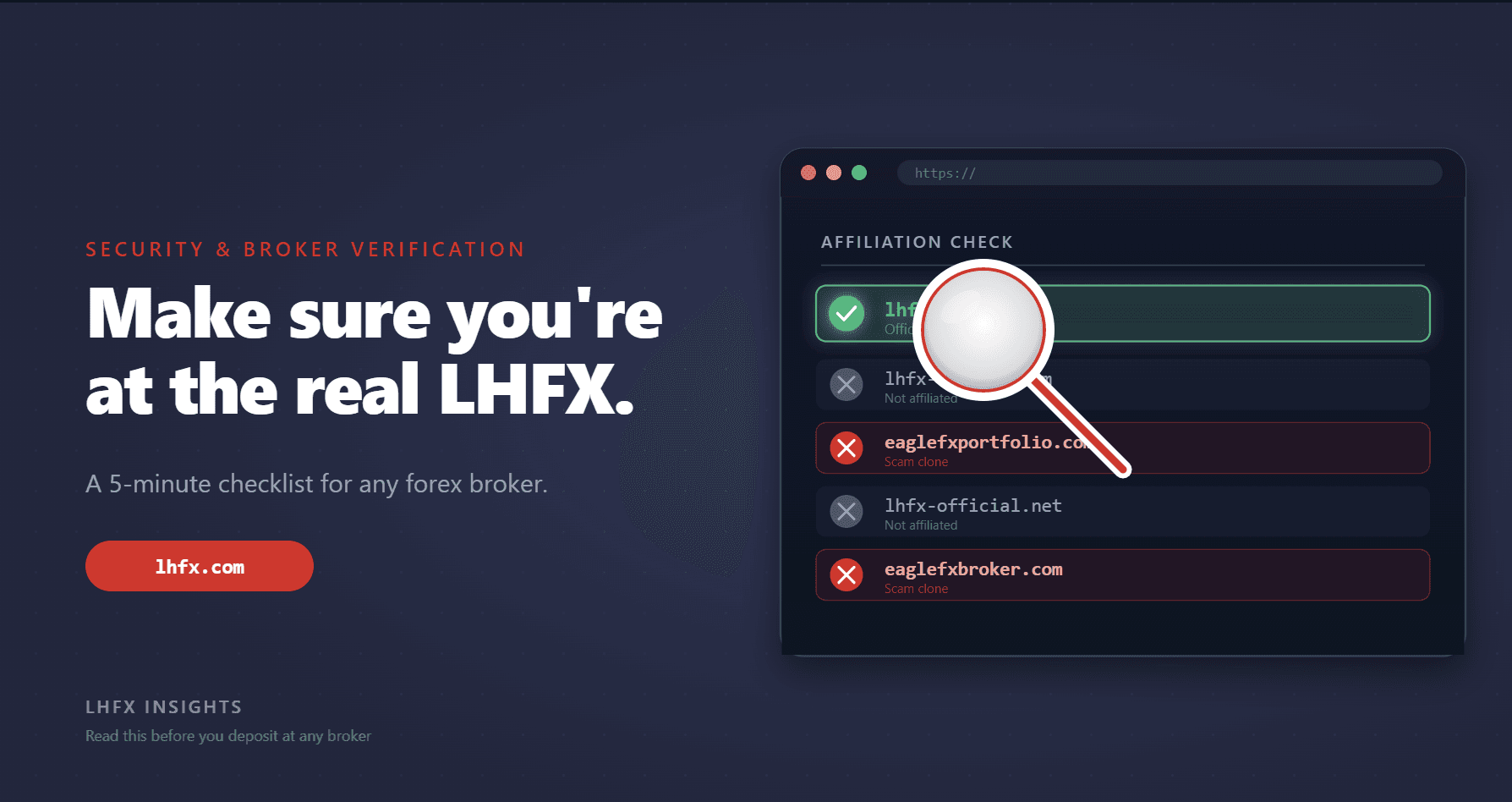
A regulated broker has a license number on a public regulator''s website. You can look it up. If a broker cannot tell you which regulator supervises them, or the "regulator" they cite is one you have never heard of (and a search turns up only their own marketing pages), walk away. Tier-one regulators include the FSCA (South Africa), FSC Mauritius, CySEC (Cyprus), FCA (UK), ASIC (Australia) and a handful of others. LHFX holds FSCA licence 52816 and FSC Mauritius licence GB23202204. Verify those directly on fsca.co.za and fscmauritius.org. The security page has the full breakdown.
2. "Guaranteed returns" or fixed monthly profit claims
No legitimate broker promises a percentage return per month. None. Forex returns are variable, often negative, and depend entirely on the trader. Anyone advertising "10 percent per month guaranteed" or "double your money in 30 days" is running a Ponzi structure, full stop. The math does not work otherwise. Walk away the moment you see that language.
3. Account managers and signal sellers
The single most common scam pattern on African forex Instagram and Telegram. Someone with a flashy lifestyle profile offers to "manage" your account, or sells signal subscriptions with screenshots of "winning" trades. The screenshots are usually demo accounts or doctored. Account managers typically take a deposit, trade aggressively, blow the account, and disappear. Real portfolio management requires a license none of these operators hold.
4. Withdrawal blockers
A broker who happily takes deposits but invents reasons not to process withdrawals (sudden "verification", new fees, dormant account charges, requests for more deposits to "unlock" funds) is the textbook end state of an unregulated broker. Check Trustpilot before you deposit. Look specifically at how the broker responds to negative withdrawal reviews. Silence or generic copy-paste responses are a red flag. LHFX is rated 4.4/5 on Trustpilot at the time of writing; you can read the responses on contested reviews and judge for yourself.
5. Recovery scams
After someone loses money to one of the scams above, a second scammer will contact them claiming to be a "recovery agent" who can get the funds back for an upfront fee. This is always a second scam. Real recovery (if possible at all) goes through your bank''s chargeback process, the regulator, or law enforcement. It does not come from a stranger in your DMs.
6. The "mentor" who wants to trade your account
Education is fine. Paid courses can be fine if the content is real. The line gets crossed when the "mentor" wants your broker login or asks you to send money for them to invest on your behalf. Once they have that access, you have no control over what happens to the account.
Why 70 to 80 percent of retail forex traders lose money
This is the statistic that brokers do not usually advertise but should. In the EU, ESMA-regulated brokers are required to publish their retail client loss rate on their websites. The numbers cluster between 65 and 85 percent depending on the broker. South African and Nigerian retail outcomes are similar; the underlying behaviour is the same.
The reasons are not mysterious. The same five problems show up over and over:
- Undercapitalisation. Starting with $50 and using maximum leverage to "grow it fast". A single losing trade wipes the account. The trader concludes forex is a scam. It was the position size.
- Over-leverage. 1:500 leverage is available because some serious traders use it sparingly on tight setups. Retail traders use it because it lets them open bigger positions than their account can support. Stop-loss hits, account closes.
- No written plan. Trading from gut feel, news headlines, or whatever the last YouTube video said. No defined entry rules, no defined exit rules, no measured edge.
- Emotional trading. Adding to losers ("averaging down"), moving stop losses further away, cutting winners early. All the human reactions that destroy expectancy.
- No demo period. Putting real money in week one. Mistakes that should have cost zero in a demo account cost real money instead. Start with a free demo account until the plan is consistent.
Traders in the 20 to 30 percent who do not lose are not smarter than everyone else. They are better capitalised relative to position size, they use a written plan, and they accept that any single trade may lose.
Is forex trading halal? (Islamic perspective)
The short answer: standard retail forex trading involves swap (interest charged or paid for holding a position overnight), which is riba and therefore not permissible under classical Islamic finance rulings. Many scholars view this as a clear barrier to ordinary forex.
The standard solution is a swap-free or "Islamic" account. On a swap-free account, the broker does not apply overnight interest to positions. Positions held past the daily rollover incur no riba. LHFX offers a swap-free option for Muslim traders; see the Islamic account page for the specifics.
Two honest caveats:
- Eliminating swap addresses the riba question, but scholars continue to debate the question of gharar (excessive uncertainty) in highly leveraged short-term speculation. Opinions vary. Trader''s intent (genuine economic activity vs pure speculation) is also discussed in different rulings.
- Some brokers replace swap with an "administration fee" that functionally behaves like interest. Read the swap-free terms carefully before assuming an account is compliant.
If the halal question is important to you, consult a scholar or institution whose rulings you follow. Brokers can offer compliant account mechanics, but the broader judgement is a religious one, not a brokerage one.
How to verify a forex broker is legitimate
Four steps. They take maybe fifteen minutes total.
- Identify the regulator and license number. Every legitimate broker publishes both. They should appear in the footer of the website and on a regulatory or security page. For LHFX: FSCA licence 52816 and FSC Mauritius licence GB23202204. See the security page for the full disclosure.
- Look the license up on the regulator''s public register. Do not trust a screenshot of a license. Type the regulator''s domain directly (fsca.co.za, fscmauritius.org, cysec.gov.cy, register.fca.org.uk) and search for the firm. If they appear, the license is real and current.
- Check independent review sources. Trustpilot is imperfect but useful. Look at the rating, the number of reviews, and specifically how the broker responds to one and two star reviews about withdrawals. Genuine engagement is a good sign. Silence or template responses are not.
- Test withdrawal early. Deposit the minimum, place a few small trades, then withdraw a portion. A real broker pays out within their stated processing time. If withdrawal becomes mysteriously complicated, you have your answer before you have committed serious capital.
If a broker pressures you to deposit more before you can withdraw, or invents fees that were not disclosed when you opened the account, treat that as a red flag and act on it.
LHFX''s approach
Since this is our blog, full disclosure: LHFX is a retail forex and CFD broker on MetaTrader 5. We are STP/ECN, so orders route to the market rather than getting internalised. Revenue comes from commission ($3 per side per standard lot) and the spread, not from client losses. Dual-regulated under FSCA licence 52816 and FSC Mauritius licence GB23202204. Client funds are held in segregated bank accounts. Minimum deposit $10, max leverage 1:500, swap-free option available for Muslim traders. Trustpilot 4.4/5 at the time of writing. Full detail on the security page.
That does not make LHFX right for every reader. It does mean the boxes a skeptical reader should check (real regulator, real licence number, segregated funds, transparent execution) are all checked.
Frequently asked questions
Is forex trading legit?
Yes. Forex is the world''s largest financial market, with daily turnover above $7 trillion according to the BIS triennial survey. Trading through a regulated broker is legitimate. The scams associated with forex are usually run by unregulated brokers, signal sellers and fake account managers, not by the market itself.
Is forex trading gambling?
No, but it shares emotional characteristics with gambling. Outcomes are not random and the odds are not mathematically fixed against you. A trader with a tested plan and disciplined risk management has positive expectancy. A trader with no plan and maximum leverage does not. The behaviour decides which.
Is forex trading legal in South Africa?
Yes. The FSCA regulates Over-The-Counter Derivative Providers, which is the category covering retail forex. South Africans can trade with FSCA-licensed brokers or with offshore brokers within their annual foreign exchange allowance. Profits are taxable; SARS treats them as income or capital gains depending on activity.
Is forex trading legal in Nigeria?
Yes. There is no Nigerian law prohibiting individuals from trading forex with international brokers. The SEC has acknowledged the existence of online retail forex and intends to regulate domestic providers. CBN policies on naira liquidity affect how banks handle foreign currency, not whether retail traders can use offshore broker platforms.
How much do retail forex traders typically lose?
Industry data from regulated brokers shows roughly 70 to 80 percent of retail clients are net losers over a given period. ESMA-regulated EU brokers are required to publish this figure; the numbers cluster in that range. Outcomes in South Africa and Nigeria are similar because the underlying behaviour (over-leverage, no plan, undercapitalisation) is the same.
How can I tell if a forex broker is a scam?
Four checks. Look up the license number on the regulator''s official website. Read Trustpilot, especially how the broker responds to negative withdrawal reviews. Deposit a small amount and withdraw it early as a test. Avoid any broker that promises guaranteed returns or pressures you to deposit more.
Is forex trading halal in Islam?
Standard forex involves overnight swap (interest), which is generally considered riba. Swap-free Islamic accounts remove that element by not charging or paying overnight interest. Scholars continue to debate other questions like gharar and the trader''s intent. LHFX offers a swap-free Islamic account as the operational solution; the broader religious judgement is one to take to a scholar you follow.
Can you make a living from forex trading?
Some traders do. Most do not. Making a living typically requires capital large enough that realistic returns (5 to 20 percent per year is what professional traders aim for) cover living expenses, plus a tested system, plus the temperament to follow it for years. Anyone claiming to make a living from a $500 account on 1:500 leverage is either lying or about to blow up. If you are starting out, start with a beginner''s guide and a demo before you scale up.
Trading is real. Most people advertising it on social media are not who you should learn from. Verify the broker, start small, write a plan, and accept this as high-risk speculation, not a salary replacement. Next, read how to trade forex.