Cet article n'est pas encore disponible en Français. Version anglaise affichée.
Forex Trading in South Africa: Basics, Tips & How to Start

Forex Trading in South Africa: How It Works, FSCA Rules, and How to Start
Forex is the largest financial market in the world, with around $7.5 trillion changing hands every day. The JSE does not come close. And South Africans have a front-row seat: the rand is one of the most actively traded emerging market currencies on the planet.
That cuts both ways. The ZAR moves a lot, which creates real opportunity. It also means beginners who treat forex like a slot machine get separated from their money quickly.
This guide covers what forex trading is, how it works in the South African context, and how to start without making the expensive mistakes most beginners make.
What Forex Trading Actually Is
Every forex trade involves a pair of currencies: EUR/USD, GBP/ZAR, USD/JPY. The first currency is the base, the second is the quote, and the price tells you how much of the quote currency one unit of the base is worth.
If EUR/USD is 1.0850, one euro buys 1.0850 US dollars.
When you trade forex, you are not converting money for a trip overseas. You are taking a position on which direction that number moves. Think of it like the petrol price: you do not own the petrol station, but if you could lock in today's price and settle the difference next month, you could profit from the move without ever touching a pump. Forex trading is that applied to currencies, settled in real time.
Two things make forex different from buying shares on the JSE:
You can profit in both directions. Think the rand will weaken against the dollar? Go long USD/ZAR. Think it will strengthen? Go short. There is no waiting for markets to go up.
Leverage is standard. Brokers let you control a position much larger than your deposit. A R2,000 deposit with 1:100 leverage controls a R200,000 position. This is why people can trade meaningfully with small accounts, and also why people lose small accounts in an afternoon.
How Does Forex Trading Work in South Africa?
In South Africa, forex trading happens through an FSCA-licensed broker via CFDs (Contracts for Difference) on currency pairs. You do not buy or hold the actual foreign currency. Instead, you open a position on the exchange rate's direction and settle the profit or loss in USD or ZAR.
Here is how a trade works from start to finish:
Choose a pair. You pick a currency pair, say USD/ZAR, currently trading at 18.50.
Choose a direction. You think the rand will weaken (USD/ZAR will rise). You go long.
Choose a size. You open 0.1 lots. On USD/ZAR, each pip movement at 0.1 lots is worth roughly $0.10 to your account.
Set a stop loss. You place a stop loss 50 pips below your entry at 18.45, risking $5 on the trade.
Close the trade. USD/ZAR rises to 18.70. You close with a 200-pip gain. At $0.10 per pip, that is $20 profit, before costs.
The broker holds margin against your position during steps 3 to 5. If the market moves against you past your stop loss, the trade closes. No ownership changes hands at any point.
The Six Terms You Need Before You Trade
Forex has a lot of jargon. You need six terms to get started.
Pip. The standard unit of price movement. For most pairs it is the fourth decimal place. EUR/USD moving from 1.0850 to 1.0851 is one pip.
Lot. The standard trade size. One standard lot is 100,000 units of the base currency. Mini lots (10,000) and micro lots (1,000) let you trade much smaller sizes.
Spread. The gap between the buy and sell price, paid on every trade. Tighter spreads mean cheaper trading. LHFX ECN accounts start from 0.0 pips.
Leverage. Borrowed exposure. At 1:100, every R1 of your money controls R100 of position size.
Margin. The deposit the broker holds against your leveraged position. If the trade moves against you far enough, the broker closes the position to protect it. That is a margin call.
Stop loss. An order that automatically closes your trade at a set loss level. Non-negotiable. Trading without one is how accounts get wiped.
Forex Trading Sessions in South Africa: When to Trade
The forex market runs 24 hours a day from Monday to Friday, but not all hours are equal. Liquidity and volatility are highest when major financial centres overlap. South Africa Standard Time (SAST) is UTC+2, which puts the main sessions at these local times:
Session | SAST Open | SAST Close | Key pairs |
|---|---|---|---|
Sydney | 00:00 | 09:00 | AUD/USD, NZD/USD |
Tokyo | 01:00 | 10:00 | USD/JPY, EUR/JPY |
London | 09:00 | 18:00 | EUR/USD, GBP/USD, GBP/ZAR |
New York | 15:00 | 00:00 | EUR/USD, USD/ZAR, USD/JPY |
London / NY overlap | 15:00 | 18:00 | Highest liquidity of the day |
For most South African traders, the London session (09:00-18:00 SAST) is the practical sweet spot: it overlaps with normal business hours, liquidity is high on EUR/USD and the rand pairs, and spreads are at their tightest. The London-New York overlap from 15:00 to 18:00 SAST is when EUR/USD moves most, making it the highest-opportunity window of the day for beginners to watch.
Avoid trading major pairs in the dead hours (midnight to 07:00 SAST unless you are specifically targeting Asian session pairs). Spreads widen and moves are choppier.
The Currency Pairs South Africans Trade
Majors. EUR/USD, GBP/USD, USD/JPY, USD/CHF. The most liquid pairs in the world, with the tightest spreads. This is where beginners should focus.
Rand pairs. USD/ZAR, EUR/ZAR, GBP/ZAR. Tempting for South Africans because the news feels familiar. Load shedding, budget speeches, and SARB rate decisions all move the rand. But rand pairs have wider spreads and bigger, faster moves than majors. They are a harder place to learn.
Crosses and exotics. Pairs without the US dollar (EUR/GBP) and thinly traded pairs (USD/TRY). Leave these until you have a solid track record on majors.
A practical note: many SA beginners start on USD/ZAR because it feels like home. The familiarity is real, but the volatility is not forgiving. EUR/USD is a better learning pair. Trade the rand pairs once you understand why you are in and out of a position, not before.
Is Forex Trading Legal in South Africa?
Yes. Forex trading through an FSCA-licensed broker is fully legal and regulated in South Africa.
The Financial Sector Conduct Authority (FSCA) regulates forex and CFD brokers as Financial Service Providers (FSPs) under the FAIS Act. Brokers offering derivative products also fall under the Over-the-Counter Derivative Provider (ODP) framework. LHFX SA (PTY) Ltd holds FSP licence 52816 and operates from Rosebank, Johannesburg.
Before depositing with any broker: verify the FSP number on the FSCA's public register at fsca.co.za. A polished website is not a licence. If a broker cannot show you an FSP number, walk away.
One important South Africa-specific point: unlike Europe, where regulators cap retail leverage at 1:30 on major pairs, South Africa does not impose a hard leverage ceiling. Brokers here can offer 1:100, 1:400, or more. That freedom is useful for experienced traders and dangerous for beginners. The regulator will not stop you from over-leveraging. That discipline has to come from you.
Forex Trading Tax in South Africa
SARS treats forex trading profits as ordinary income, the same as a salary.
The full profit is added to your taxable income for the year.
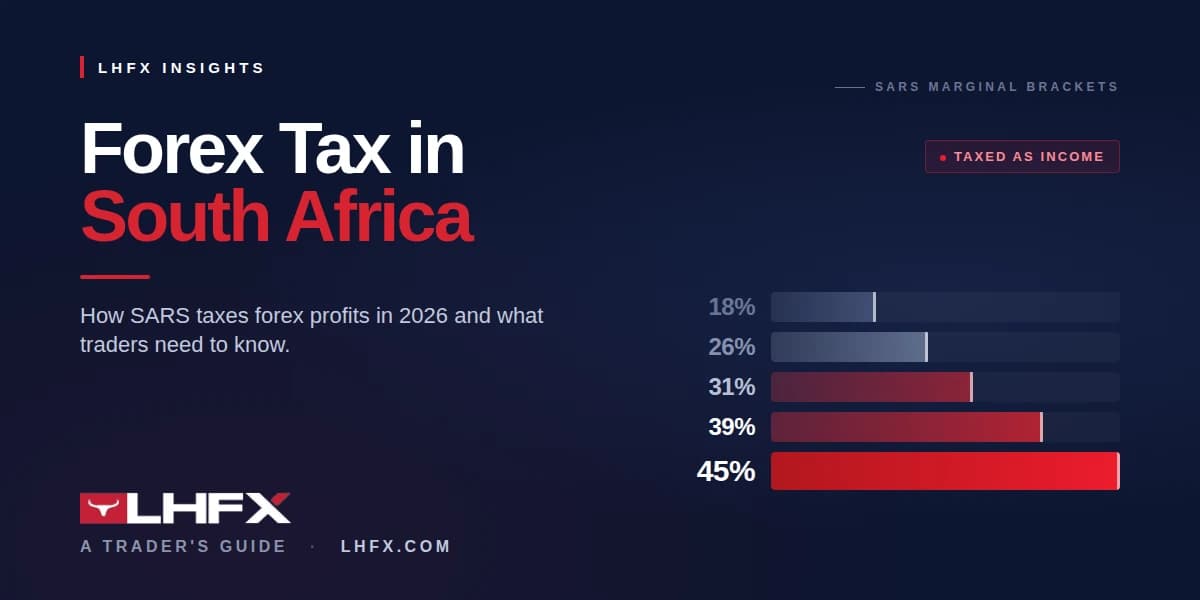
It is taxed at your marginal rate, which runs from 18% to 45%.
Trading losses can generally be offset against trading profits, but ring-fencing rules apply if losses are recurring year after year.
There is no capital gains treatment for active forex trading. Holding a position for a while does not change the tax character.
Keep a record of every trade with the ZAR value of the profit or loss. If your activity is meaningful, register as a provisional taxpayer and consult a tax practitioner who handles trading income. See our guide to forex and CFD tax in South Africa for the full breakdown. (This is not tax advice.)
Funding a Forex Account from South Africa
South Africans can move money offshore under two SARB allowances:
Single Discretionary Allowance: R1 million per calendar year, no tax clearance needed.
Foreign Investment Allowance: a further R10 million per year, requiring a SARS tax compliance status PIN.
Retail trading deposits fall well within the discretionary allowance for most traders. Practical funding routes for depositing with LHFX:
Cards. Visa, Mastercard, Apple Pay, and Google Pay. Your bank handles the ZAR-to-USD conversion at its rate.
E-wallets. Skrill and Neteller both support ZAR funding from SA bank accounts.
Crypto. Often the fastest route. A common workflow is buying USDT on a local exchange via ZAR EFT, then sending it to the broker. No card FX fees and it lands in minutes.
LHFX charges zero fees on deposits and withdrawals, with an average withdrawal time under 12 minutes.
How to Start Forex Trading in South Africa: Five Steps
Step 1: Open a free demo account. Virtual money, live prices, real platform. Trade it like it is real. If you cannot stay disciplined with fake money, real money will not fix that.
Step 2: Learn one pair properly. Pick EUR/USD. Learn how it moves during the London session, around US data releases, and at the London-NY overlap. Depth on one pair beats shallow knowledge of ten.
Step 3: Build a written plan. Entry rules, exit rules, a stop loss on every trade, and a maximum risk per trade of 1% to 2% of your account. If you have not written it down, it is not a plan, it is a mood.
Step 4: Go live small. Micro lots, low leverage, money you can genuinely afford to lose. The goal of your first three months live is not profit. It is following your plan under real emotional pressure.
Step 5: Journal every trade. Record why you entered, why you exited, and what you felt. Patterns in the journal are worth more than any indicator.
Mistakes That Kill Beginner Accounts
Using maximum leverage. Position size for the volatility of the pair, not the maximum the broker allows. Most blown accounts are leverage stories, not analysis stories.
Trading without a stop loss. "I will close it manually if it goes wrong" is what everyone says before the trade that does not come back.
Starting on ZAR pairs because they feel familiar. Familiar news does not mean forgiving price action. Rand pairs are wider and wilder than majors.
Revenge trading. Losing a trade and immediately doubling size to win it back. This is how a bad morning becomes a closed account by lunch.
Paying for signal services. Telegram groups promising 90% win rates are selling subscriptions, not profits. If their signals worked reliably, they would not need your R500 a month.
Skipping the FSCA check. Verify the FSP number on the public register before depositing. No licence, no money.
Start Forex Trading with LHFX
LHFX SA (PTY) Ltd is regulated by the FSCA under FSP licence 52816, with offices in Rosebank, Johannesburg. You can trade 41 forex pairs alongside 10 crypto CFDs, global indices, and commodities from one MetaTrader 5 account.
Condition | Detail |
|---|---|
Minimum deposit | $10 (around R180) |
Spreads | From 0.0 pips |
Commission | $3 per side ($6 round-trip per standard lot) |
Execution | STP/ECN, no dealing desk |
Platform | MetaTrader 5 (MT5), iOS and Android |
Forex pairs | 41 pairs (majors, minors, exotics) |
Average withdrawal time | Under 12 minutes |
Deposit and withdrawal fees | Zero |
Demo account | Free, unlimited, live spreads, no time limit |
Start on the free demo account: same prices, same platform, zero risk while you build the habits that keep accounts alive. The market will still be there when you are ready.
Open your free LHFX demo account
Frequently Asked Questions
Is forex trading legal in South Africa?
Yes. Trading through an FSCA-licensed broker is fully legal and regulated under the FAIS Act. You must declare profits to SARS and pay tax on them as ordinary income.
How much money do I need to start forex trading in South Africa?
LHFX accounts open from $10 (around R180). A more realistic starting balance for proper position sizing with micro lots is R2,000 to R5,000, using only money you can afford to lose entirely.
How much can I make trading forex?
There is no fixed answer, and anyone who gives you one is selling something. Most retail traders lose money in their first year. Sustainable returns come from risk management and consistency, not from any single trade or signal service.
Do you pay tax on forex trading in South Africa?
Yes. SARS taxes forex trading profits as ordinary income at your marginal rate, from 18% to 45%. Keep records of every trade in ZAR terms from day one.
What leverage should a beginner use?
Far less than the maximum available. Risk 1% to 2% of your account per trade and let that rule determine your position size. The leverage number on the account matters less than how much of it you actually use.
Can I trade forex from my phone in South Africa?
Yes. MT5 runs on iOS and Android with full charting and order management. Most traders use desktop for analysis and mobile for monitoring open positions.
What are the best forex trading hours for South African traders?
The London session (09:00-18:00 SAST) is the most practical window for most SA traders. The London-New York overlap from 15:00 to 18:00 SAST has the highest liquidity and tightest spreads on EUR/USD and rand pairs.
Do I need to trade ZAR pairs as a South African?
No. You can trade any pair your broker offers. Most beginners are better served learning EUR/USD before moving to rand pairs, which are more volatile and carry wider spreads.
Risk warning: CFDs are complex instruments and come with a high risk of losing money rapidly due to leverage. Consider whether you understand how CFDs work and whether you can afford to take the high risk of losing your money. Past performance is not indicative of future results. This article is for informational purposes only and does not constitute financial, investment, or tax advice. Consult a licensed financial adviser and tax practitioner before making any financial decisions.